Blog
Managed properly, it could accelerate innovation across the business

By Femke van Engen, project lead, and Olivier Lamers, data scientist at Rewire.
Let’s play make-believe.
You manage enthusiastic non-technical teams who interact regularly with technical teams. For example, to improve workflows, flesh out new ideas, or analyse data. The problem is that there is only so much your technical teams can handle.
Still, you'd like to improve collaboration between technical and non-technical teams and, more broadly, accelerate your organisation's innovation capabilities.
Well, vibe coding might be part of the answer.
But what, exactly, is vibe coding?
What vibe coding means
Put simply, vibe coding means describing what you want in plain natural language, and an AI tool turns it into working software in minutes. No coding skills needed. No briefing an engineer who sends you back to the drawing board until you’ve figured all the unknowns. No begging a tech lead whose next free slot is in six weeks.
The result? An idea that would have taken a few sprints to render visible can become a working prototype in less than an hour.
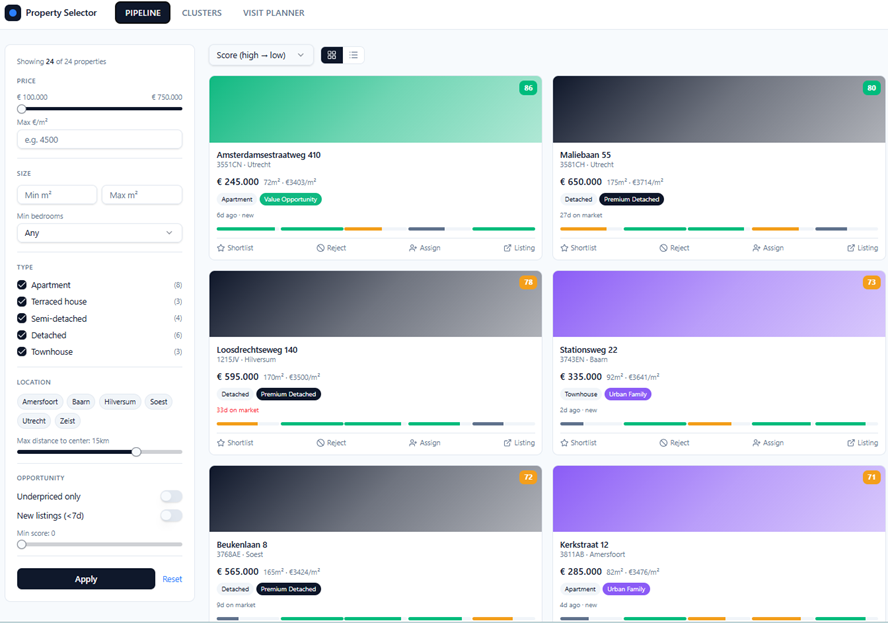
Still on the fence? Check out this web app that was put together by a senior exec in one of our recent vibe coding workshop. She had never coded before, yet built a Property Selector in under an hour — a desktop app that automatically scores, filters, clusters and assigns scraped real estate listings into optimised scout-visit schedules, helping investment analysts identify the best opportunities and plan field visits more efficiently.
The best part: no particular setup was needed. Just a Lovable account and her laptop.
Figure 1. From vague idea to detailed prototype in under an hour.
Why vibe coding accelerates innovation
The practical benefits of translating an idea into a working prototype that fast are straightforward:
- Speed to output. An idea becomes something your non-technical teams can show and react to in minutes instead of weeks. The distance between thinking and doing collapses.
- Better conversations. A working prototype beats a slide deck or a written brief. Fuzzy ideas become concrete. Requirements and variables are better defined. Your non-technical teams are better prepared and the translation gap from the person who understands the business problem to the person who can render it in code is vastly reduced.
- Lower cost of being wrong. If the concept does not hold up under scrutiny, your non-technical team finds out in an afternoon, not after a development sprint.
What vibe coding won't do
Ok. We’ve convinced you since you made it this far. There are, however, a couple of caveats.
First of all, the constraint now is conceptual, rather than technical: the quality of what you generate depends almost entirely on the quality of your thinking before you start. Define what you want (and don’t want!) clearly and a single well-constructed prompt will produce something impressive. Let’s be very clear: the best results tend to come from spending roughly 80% of the available time on definition and scoping, and 20% on generation. The AI is not a substitute for thinking.
Second, do not rush to make your IT team redundant. Vibe coding is great to build prototypes running on a laptop that overheats when you have more than 3 browser tabs open. But don’t expect to put this in production within hours. There are simply too many issues that need to be addressed first: cybersecurity, data sovereignty, governance, integration with legacy systems, to name a few. So stay friends with your technical team, and use vibe coding to improve the quality of the discussions between your technical and non-technical teams.
The main takeaway
Vibe coding won't replace good thinking, or your technical teams. It will show you and your business teams, whether an idea is worth their time, faster than ever.

The best prototypes start with the best thinking.
You don't need to know or write code. You need to describe what you want in terms that are clear to an AI. That skill alone will let you and your teams turn ideas into working prototypes, improve discussions with technical teams, and accelerate innovation.
Find out more


