Blog
The biopharma industry already operates like a multi-agent system, just without the agents.

Recent AI agent performance research show that AI agents now achieve near 100% success on tasks that take a human under 4 minutes, but less than 10% success on tasks over 4 hours. In other words: the longer the task, the less reliable agents are. The issue appears to be structural: making the agent smarter will not fix it. Redesigning tasks, however, can.
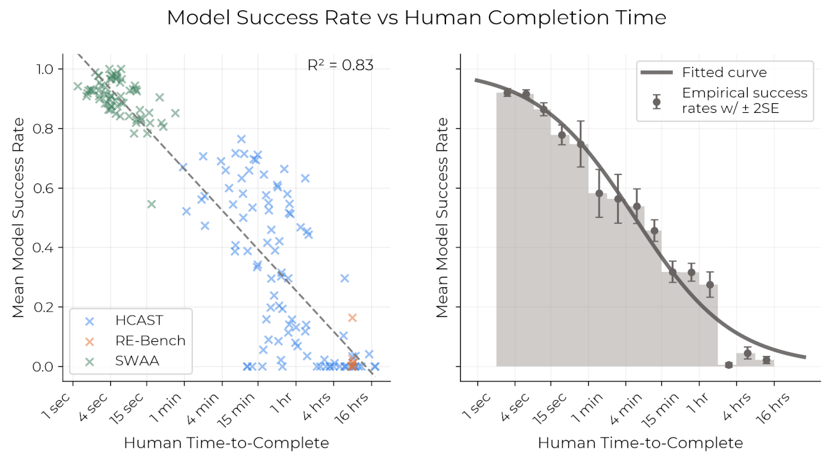
Figure 1. Model success rate vs Human completion time. Source: Kwa et al. (July 2026). Measuring AI Ability to Complete Long Software Tasks. https://arxiv.org/pdf/2503.14499
Why generalist AI agents fail, especially in biopharma
In the context of the biopharma, building one generalist agent and load it with context across regulatory, scientific, commercial, and clinical domains is inefficient. A generalist agent trying to manage regulatory compliance, synthesise scientific evidence, and sketch reimbursement pathways will hallucinate or won't go deep enough. It might be 90% right on average, but you'll never know which 10% is wrong. And one flawed reasoning step will cascade through the entire chain. In biopharma, that's an unacceptable risk.
Software engineering learned this lesson in the 2000s. Giant monolithic codebases are hard to debug or to scale. The answer was microservices, with independent modules, deployment, and validation.
The same logic now applies to agentic AI in biopharma.
The orchestration answer: specialised agents with human decision gates
Translating the logic of microservices into agentic AI systems for biopharma, the orchestration approach gives this:
- Small agents, each excellent at one narrow task. A regulatory agent that only checks compliance. A science agent that only reviews evidence. A market agent that only models reimbursement.
- Each agent can be validated independently. You can test the regulatory agent against known regulatory outcomes. You can't test a generalist agent against "everything.“
- Guardrails are built into the architecture. Validation gates between agents. If the regulatory agent flags a problem, the pipeline stops before the market agent wastes cycles on an invalid pathway. Guardrails must be structural, as we explain here.
- Humans stay in the loop at the right moments. Not reviewing every output, but sitting at decision gates between phases. The architecture defines where human judgment matters most.
- It scales. Need to add a new domain? Add a new agent. Need to improve regulatory accuracy? Retrain one agent, not the whole system.
While most industries adopting agentic AI have to build governance frameworks from scratch, biopharma already has this. The decision-gate architecture — specialised agents operating within human checkpoints — maps directly onto how pharma already works. Regulatory affairs, medical affairs, clinical development, market access: each function already has defined review cycles, sign-off requirements, and clear accountability structures. This is the multi-agent orchestration model.
Why pharma is the perfect domain for agentic systems
Developing a single drug takes 10-15 years and $1-2.6B. A significant share of that cost is coordination overhead: re-reading, re-synthesizing, waiting for reviews, reconciling conflicting inputs across functions. An analysis of 270 life sciences workflows (1200 tasks) and found that 75-85% contain tasks that could be automated or augmented by AI agents, potentially freeing 25-40% of organizational capacity.
Take medical content creation. A single piece of promotional content currently moves through approximately seven sequential review cycles across medical, legal, regulatory, and localisation. Each reviewer waits for the previous one. Average cycle: six to eight weeks.
Under an orchestrated multi-agent model, a drafting agent produces the initial version. Medical accuracy agents and regulatory compliance agents run in parallel. Localisation agents adapt for local markets simultaneously. Humans approve at two defined gates: after the initial draft and after the final review. The cycle collapses from weeks to days, while the quality controls remain intact.
The same logic applies across the pipeline: pharmacovigilance monitoring, regulatory submission drafting, protocol design, site selection, KOL mapping. In each case, the opportunity is not to replace human judgement, but to remove the coordination overhead that delays it.
The gap will be measured in pipeline years
Enterprise application of agentic systems is growing at nearly 50% compound annually, and the microservices approach is becoming the dominant architecture for AI agents. For pharma, organisations that get the orchestration right will soon gain years of pipeline advantage.
Philipp Diesinger leads the pharma Practice Area at Rewire.
Sources:
- Gartner Hype Cycle for Agentic AI, 2025 | Gartner Newsroom, Aug 2025
- SagaLLM, arXiv 2503.11951 | Du et al., "Improving LLM Reasoning with Multi-Agent Debate," arXiv 2305.14325
- IDC; PMC (NCBI PMC6372467)
- McKinsey, "Reimagining Life Science Enterprises with Agentic AI," Sep 2025
- Bain & Company, "How to Make Your Drug Launch a Success"
- DiMasi et al. (2020), PubMed 32125404
- GMP Pros / Farseer (2023)
- Grand View Research, Pharmaceutical Regulatory Affairs Market, 2024

Agents reward organisations that ask harder questions first.
The organisations getting compounding value from agentic AI share one trait: they invested in getting the foundations right before scaling.
We've built agent systems across financial services, energy, telecom, and public sector, from early proofs of concept to production systems running at scale. We've seen what separates the deployments that deliver from the ones that don't.


