Blog
Organisations that govern their knowledge are about to pull ahead of their competition

By Marcel Mol and Job van Zijl, Rewire.
Companies looking to scale agentic systems quickly run into a limitation: AI is only as intelligent as the knowledge it can draw upon. While LLMs let organisations open up sources that were previously hard to utilize, such as PDFs and Word documents, the fact is that businesses aren’t documented the way they need to be to fully leverage today’s technology.
Three problems arise:
- Knowledge is tacit, internalized by employees and never written down.
- Knowledge is imperfect, with out-of-date information, discrepancies between sources, and so on.
- Knowledge is missing.
To solve these problems, we introduce the knowledge engine methodology, underpinned by a broader vision: the codified enterprise. This is how we define the winning organisations of tomorrow — where knowledge compounds rather than churns, and where agents can be deployed reliably at scale.
How the codified enterprise develops asymmetric competitive advantage
Today, organisational expertise is siloed by design: it belongs to individuals and teams, rather than the organisation as a whole. People do most of the work, and AI augments specific processes as and when needed.
Agentic AI flips is set to flip the equation around, with agents doing most of the operational work, while people oversee strategy, creativity, and edge cases. But this is only possible with a governed knowledge layer that agents and humans can query and maintain. Knowledge — rather than churning out of the door whenever someone leaves — becomes a compounding asset.
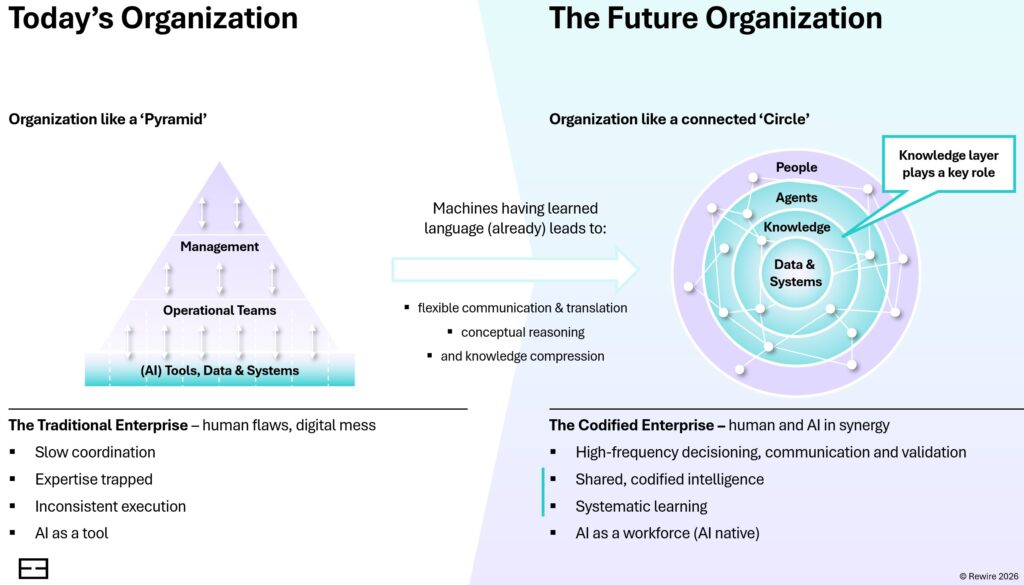
Think about what this means operationally: the codified enterprise can onboard a new agent in hours rather than weeks, because the knowledge it needs exists in structured form. It can scale a process across markets with improved institutional memory. It can respond to regulatory change by updating a knowledge graph and propagating the change systematically, rather than hoping that the right people update the right documents and that those documents get read.
The non-codified competitor, meanwhile, is still dependent on specific individuals, still recreating knowledge from scratch, still debugging agents that behave inconsistently because their prompts are patching over gaps in an unstructured information environment.
Building tomorrow’s codified enterprise
Building a codified enterprise starts with addressing three challenges:
- Making all knowledge machine-readable. The issue here is that most business knowledge lives in people’s heads, unstructured documents, or process tooling that agents cannot access. None of it is governed or current.
- Knowledge extraction taking human effort. Even where documentation exists, it is incomplete and ungoverned. The decision rules that experienced people apply intuitively — when to escalate a claim, how to handle an exception — are rarely written down. Structuring this for autonomous agent use still requires people to validate and sharpen what gets captured.
- Knowledge is never finished. Processes change. Thresholds shift. Regulations evolve. A knowledge system not designed to update continuously will decay — and agents grounded in stale knowledge become unreliable.
The knowledge engine methodology uses process documentation as input, and allows expert validation of the acquired knowledge. But there’s more to it. As a video is worth more than a thousand words, check out the video demo below. You’ll see how the knowledge engine in action, as well as:
- How knowledge can be extracted following an expert-defined ‘knowledge skeleton’, applied to building a knowledge graph from internal policy documents
- How to the extracted knowledge can be visualized, and gaps and contradictions can be made visible
- How AI can help closing these gaps by suggesting fixes, which can be approved or changed by experts
Watch the video
Curious about what a knowledge engine could do for your organisation? Get in touch!


