Blog
Why every C-level executive needs a vision for AI-native organisations

Foreword
The writing is on the wall: AI technology is accelerating faster than enterprise adoption can keep up. The industry has woken up to the fact that deployment — not model capability — is becoming the real bottleneck to scalable, transformational impact. The narrative is shifting from model improvement to the AI diffusion gap. OpenAI, Google and Anthropic are moving downstream through JVs, alliances and service partnerships to de-bottleneck implementation and pave the way for enterprise value creation.
In abstract terms, this diffusion challenge is familiar: new technology is being applied to old paradigms. History is full of examples where technologies only captured their full potential once the context around them was redesigned. The shift to AI-native organisations has only just begun, but its first contours are becoming clear.
AI is not simply another technology layer added to the existing organisation. It is a new operational substrate for how decisions are made, knowledge is applied, and work gets executed. The implication is not merely that people will work differently with AI software, but how organisations are redesigned around intelligent systems.
Most modern enterprises were built to compensate for human limitations: limited memory, limited context, limited coordination capacity, and limited cognitive bandwidth. That is why work is fragmented into departments, management layers, workflows, meetings, approvals, handovers and systems of record.
AI changes the economics of cognition itself. For the first time, we can build systems that reason across vast amounts of information, coordinate activities in real time, learn from feedback, and execute workflows end-to-end. This does not simply improve existing processes. It challenges the assumptions on which those processes were built. Much of what we traditionally classified as “knowledge work” — analysis, coordination, judgement, synthesis — is no longer uniquely human but rapidly becoming automatable at scale.
That is why many AI initiatives fail to create meaningful impact. Companies insert AI into organisational structures, infrastructure and systems that are fundamentally incompatible with AI’s full potential. A smarter chatbot here. A copilot there. Ten fragmented optimisations inside an unchanged system architecture.
The real productivity leap does not come from ten steps becoming twenty percent faster. The organisations that lead in the coming decade will be those that redesign their operating model around intelligent systems first. We call these organisations AI-native.
This paper describes what that future looks like: why AI-native organisations emerge, how intelligent systems reshape organisational design, why knowledge and decision-making become part of the digital backbone, and why competitive advantage increasingly depends on feedback loops, orchestration, and the continuous evolution of operational intelligence.
The transition does not begin with a massive transformation programme. It begins by redesigning one core process end-to-end around AI — and learning from deployment.
Start small. But think radically.
Wouter Huygen, CEO Rewire
|
▶
|
Each section below can be expanded. Click a heading to read more. |
Suddenly AI is everywhere
And yet, for the vast majority of organisations, successfully designing, building and scaling AI solutions remains a complex challenge. Data is fragmented, organisations are complex, and a lot of the work relies on the tacit knowledge internalized by employees. Real bottom-line results often take a long time to materialise.
Most organisations start their AI journey pragmatically: they want more efficiency and scalability relative to the current way of working. Think of a large call centre that needs to handle more information requests quickly, or an insurer that wants to clear a large claims backlog. All legitimate use cases — but the real possibilities of AI are far more disruptive. More and more Rewire clients see this too. Instead of looking for ways to make the old way of working slightly more efficient, they ask a far more ambitious question: “How can we completely rebuild that way of working around the power of AI technology?”
The real possibilities of AI are far more disruptive than a faster version of the old way of working.
AI-native: letting go of the human lens
Until the end of the nineteenth century, factories were built around a single central steam engine, with a complicated system of shafts, belts and gears to distribute power to all parts of the production line. The electric motor initially only replaced that central power source, resulting in a relatively modest increase in productivity.
Only when manufacturers equipped each component with its own electric motor could they completely reorganise their entire factory floor. Workflows became more linear, logistics more efficient, working conditions improved dramatically. Thus the invention of the electric motor produced a significant rise in productivity only decades later - once the entire organisation and infrastructure had been redesigned around it.
Birth of the AI-native organisation
AI systems are rapidly expanding their ability to assess information, make decisions, evaluate results and plan ahead. This, in turn, creates the opportunity to reorganise core processes and entire organisations around the power of AI. This is the prelude to the birth of the AI-native organisation.
The vast majority of the work done in offices, factories, warehouses and other workplaces consists of repeated patterns: the ‘assembly line of the knowledge work era’. Current AI technology can already perform much of that work faster than humans. Humans are, after all, not optimised for repetitive information work. This is why organisations will inevitably emerge where AI becomes central to all decisions and execution.
Organisations will inevitably emerge where AI becomes central to all decisions and execution.
Instead of a complex organisational chart with management layers, functions and silos, a much flatter organisation will emerge, one that operates many times more efficiently and responds faster to new developments. But getting there requires courage and a visionary mindset from C-level decision-makers. One where they can no longer view their company through a human lens.
Knowledge and decision-making as the digital backbone
The number of AI pilots increased spectacularly last year. More and more organisations are so enthusiastic about the possibilities of AI that every department starts experimenting on its own. This is currently creating a real proliferation of AI pilots. Unfortunately, the real AI experts within an organisation are usually scarce. Moreover, scaling up pilots requires large investments at many different levels (data, technology, organisation, and so on). It is therefore usually far more productive to focus efforts on a few strategic projects with a clearly described ROI.
In its most disruptive form, a strategic AI pilot can become an entirely new entity alongside the existing business. This form of greenfield incubation delivers results particularly when it is possible to work entirely around existing (legacy) technology. To generate momentum and results more quickly, at Rewire we tend to opt for ‘reinvention from the inside out’: select a core process, redesign it end-to-end as an intelligent system, and scale from there.
Digitising knowledge and decision-making
For example, we are currently redesigning the fault-handling processes involving a 1,400-employee call centre for a major Dutch telecom player. They had operated for years via a deterministic step-by-step plan: employees worked through a fixed series of questions and checks to identify the problem. One of the many inefficiencies: employees who were paid based on call duration were too quick to send out a technician or a new modem. The vast majority of returned modems still worked perfectly.
An AI assistant currently supports these employees to diagnose faults. The system reads the network directly and simultaneously guides the employee through the conversation with the customer. This not only significantly reduces call time, but also the number of technician visits and hardware replacements, while customer satisfaction increases significantly. In the longer term, this system optimisation — in which instead of an individual link being improved the entire chain has been redesigned around the optimal outcome — will replace employees entirely.
In the new call centre situation, knowledge and decision-making all become part of the digital system.
Previously, the digital system of the call centre served primarily for execution and recording, while people did the decision-making. In the newly optimized system, knowledge, information and decision-making all become part of the digital system. These AI systems consist of four layers:
The four layers of a state-of-the-art AI system
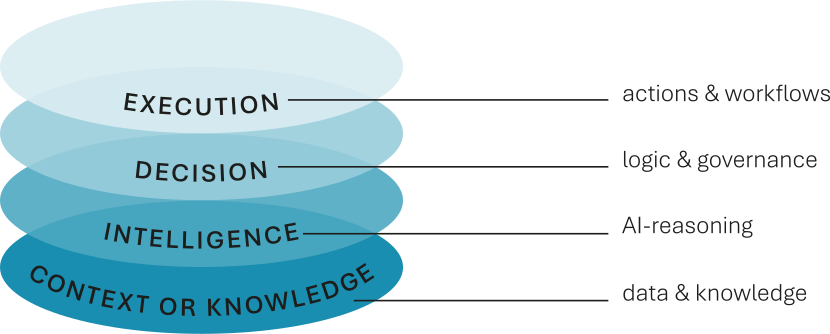
Context or Knowledge Layer Everything starts here. This layer is the knowledge base on which the entire system runs, and usually the most underestimated. The real bottleneck in AI implementations lies rarely in the model, but in the quality and accessibility of the underlying information, and the way in which this information is structured and fed to the AI model. This information encompasses structured and unstructured data as well as the implicit expertise that resides in employees’ heads and has never been written down. Ontologies (more on this later) play a major role here.
Intelligence Layer The reasoning engine of the system. This is where the AI agents live. They convert raw information into understanding: large language models, specialist models and reasoning engines that work step by step through complex issues. They do not reason on the basis of fixed rules, but on the basis of pattern recognition. They can therefore respond in situations they have never ‘experienced’ before. In modern AI architectures, this layer increasingly consists of multiple specialised models working together, each good at a specific task, directed by an overarching orchestration system.
Decision Layer The layer that converts reasoning into decision. This is where the decision logic of the organisation lies: thresholds, responsibilities and the boundaries of autonomy. What does the system handle independently, what requires human judgement, and when is escalation triggered? This layer underpins a fundamental shift: systems handle what is clear and repeatable; people focus on what is nuanced or risky. Which decisions the system may make is therefore not a technical question, but a strategic and legal one.
Execution Layer Where the system interacts with the world. Decisions are converted into concrete actions: customer communication, system updates, supplier contact, instructions to other agents. Unlike classic process automation, AI agents/systems here do not work on the basis of a fixed script, but on the basis of a goal: they recognise exceptions and take alternative paths. As the layers above become more sophisticated, people focus more on designing, monitoring and further developing the system as a whole.
From ontologies to self-improving decision systems
Organising knowledge in a way that machines understand it is one of the most important AI challenges of the moment. Neglecting this aspect greatly increases the chance that AI models draw the wrong conclusions – the dreaded ‘hallucinations’. The solution comes in the form of specialised databases. These so-called knowledge graphs organise data from a large number of (un)structured sources in a way that is optimally accessible to AI models. These knowledge graphs, in turn, are derived from ontologies.
Ontologies (popularised by AI software pioneer Palantir) are the definitions of the objects that exist, the relationships between them, and the rules governing those relationships. Taking the previous example of the fault-handling process at a telecom company, this would include the definitions and properties of a ‘customer’, and how the concept of ‘customer’ relates to other concepts such as ‘data subscription’, ‘internet connection’ and ‘faults’.
Self-improving decision systems
Self-improving decision systems not only record what happens in an organisation, but also why. On the basis of what information are decisions made, what options were considered in previous decisions, and what was the ultimate result of that decision? This decision history itself serves to update all relevant components in the system. This distinguishes them from traditional knowledge systems: they’re not a static archive of facts, but a self-improving system that converts organisational knowledge into ever-sharper judgement.
The three layers of self-improving decision systems.
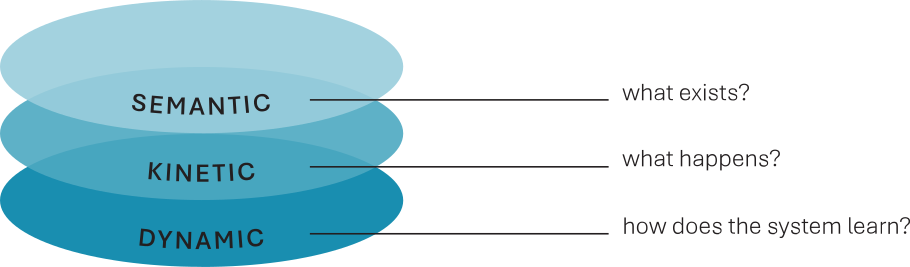
Layer 1 – Semantic: what exists? The semantic layer defines all relevant objects and their mutual relationships: what is a customer? An internet connection? A fault? In practice, departments and systems often use different definitions. The semantic layer creates one shared, structured model. This creates the common language that AI needs to reason reliably. Without this foundation, an LLM produces answers that are internally consistent but factually incorrect for your specific context.
Layer 2 – Kinetic: what happens? The kinetic layer adds processes and actions: which steps are taken? Which decisions made? Which actions are possible? This is the layer that enables autonomously operating AI systems (such as AI agents) to advise, and, crucially, to act: initiate an action, prepare a decision, signal an exception. Many AI implementations stall at the advisory stage. The kinetic layer is the bridge between advice and execution.
Layer 3 – Dynamic: how does the system learn? The dynamic layer describes how the system learns from new information and optimises itself on the basis of feedback. It’s the difference between a system that becomes outdated and one that grows with the organisation. Competitive advantage lies not in the (rapidly commoditising) model itself, but in the quality of the feedback loops. Organisations that set this up well build a system that gets a little better every day.
Impressive figures from financial frontrunners
The result is a ‘self-learning digital backbone’ that increasingly weaves itself into the core of the business. The way people collaborate within that company changes structurally, just as it did with earlier digital transformations. Because these systems automate the way of working end-to-end, there is less need for all kinds of separate departments or silos.
The required specialist knowledge resides in the Context (or Knowledge) layer and in the AI models. The role of human employees is therefore becoming that of a supervisor. They use their knowledge and experience not to carry out the work, but to continuously optimise the processes done by AI systems. A single specialist now manages what was previously the work of a team. We see this development prominently in financial services, for several good reasons:
- At its core, the financial services industry is a digital information business.
- Checking rules (compliance) is highly automatable.
- Many decisions are rule-driven, and therefore automatable.
- The combination of inefficiencies and high margins creates an opening for more efficient competitors.
A good example of a financial services provider that has made enormous impact with its AI-native approach is Ant Financial. Thanks to its ecosystem built around e-commerce giant Alibaba and the Alipay payment platform, it has access to vast amounts of customer data: from credit scores and transaction behaviour, to payment patterns and reputation scores. The AI system of Ant Financial’s fully automated MYBANK uses this data for, among others, its groundbreaking and highly successful ‘3-1-0’ model.
After a 3-minute intake, every applicant hears within 1 second and 0 human intervention whether they will receive a loan. A significant portion of applicants were previously turned away by traditional banks due to insufficient collateral or credit history. Thanks to this AI-driven credit provision, MYBANK has now financed 53 million SMEs, without any physical branches being involved. The following figures show which AI-native processes Ant Financial developed for its ecosystem:
- The MYBANK system analyses more than 3,000 variables per applicant. This results in a default rate of just 0.38 percent, compared to an industry average of 1.9 percent.
- Ant Financial’s insurance division operates a ‘2-1-2’ model: claims assessment in 2 minutes, decision in 1 second, payout within 2 hours.
- In MYBANK’s first year (2015), the share of self-service in customer service rose from 60 to 94 percent. Two years later, the quality of AI-driven customer service exceeded that of human employees for the first time.
- Thanks to AI agent Antom, web shops connect to Ant’s payment network within minutes. Competitors often take 5 to 10 working days.
MYBANK shows what happens when an organisation organises itself around the latest possibilities of AI technology.
Speed of learning as the new competitive advantage
MYBANK is a compelling example of an AI-native financial institution. Every core process — from credit assessment and risk management to customer service was designed from the ground up around AI. It shows what happens when an organisation no longer organises itself around human capabilities, but around the latest capabilities of AI technology. In doing so, some of the human limitations largely disappear:
- A person can only process a limited amount of information. And so we break work into manageable tasks, distribute them across departments, and record handover moments in processes and systems. Every handover is a concession to our cognitive bandwidth.
- A person needs focus and cannot know everything about everything. And so we organise expertise in silos — legal, finance, marketing, operations, risk — and build coordination layers to make those silos talk to each other. Management is the glue that holds those specialisms together.
- A person works relatively slowly, irregularly and unpredictably. And so we phase decision-making into weekly meetings, monthly reports and quarterly cycles, with batches, queues and escalation paths — because real-time handling simply lies beyond our reach.
- A person is expensive, scarce and inflexible. And so we strive for standardisation: one process for all customers, one work instruction for all employees, one decision tree for all cases. Personalisation at scale is economically unfeasible as long as people do the work.
- Transferring human expertise is complex and time-consuming. And so we invest heavily in training, procedures and manuals to capture knowledge — while an important part of all organisational knowledge resides mostly in the heads of experienced employees.
MYBANK shows what happens when an organisation organises itself around the latest possibilities of AI technology.
The architecture of every modern organisation is in fact an optimisation to compensate for the above limitations. It’s a structure that has been developed over the years to allow a group of people working inefficiently to work towards a particular goal as quickly and efficiently as possible.
C-level executives who want to unlock the full power of AI must let go of this human-centric lens. Instead, they must develop a vision for rebuilding their organisation with an AI-centric lens: identify a process to reshape — and rebuild it with AI from the ground up.
In practice, however, we see pilots with marginal results: a slightly more efficient version of the way of working that they are supposed to replace. The scarce AI expertise within an organisation becomes fragmented across dozens of small experiments that individually lack the critical mass to fundamentally change anything. By all means start small, but make sure that the thinking is radical.
New process with AI as the starting point
Take the handling process of the aforementioned call centre, which consists of a fixed series of manual steps. The customer calls in, an employee identifies the customer and consults the customer history, classifies the question, searches for the answer in a knowledge base, implements the solution in the source system, and records the conversation for follow-up. Each of those steps requires attention, context and manual work.
The reflex of many organisations and suppliers is to develop point solutions for one of those steps. A smarter IVR that routes customers better. Speech recognition that transcribes the conversation. An AI assistant that whispers suggestions to the agent from the knowledge base. Each component is now slightly faster. But at most this results in a process that still consists of all individual steps — only slightly more efficiently.
The AI-native way of working is fundamentally different. Instead of looking at how each one of the ten steps can run slightly faster, we turn the question on its head: if we were to redesign this entire process today, with current AI capabilities as the starting point, what would it look like?
The answer is not a series of ten slightly smarter steps, but one coherent intelligent system. The customer asks their question, and the system does the rest in one continuous flow: it recognises the customer, reads the relevant systems directly, diagnoses on the basis of real-time data and measurements from the network, understands the context of the question, consults the required knowledge, makes the decision, takes action, communicates the result, and records everything for future learning. What were previously ten handovers between people, screens and systems is now one integrated action.
Why the four layers of AI systems underpin AI-native organisations
The individual steps do not disappear because they are automated, but because they no longer need to exist separately. They were primarily an organisational solution for the human limitations we described earlier: the necessity to break up, distribute, coordinate and transfer work. An intelligent system that unites the four layers (context, intelligence, decision and execution) does not know these limitations. Because the silos disappear, AI systems can at any moment, in real time, incorporate the complete organisational context into decision-making. Existing management processes thereby become superfluous.
This is where the real productivity leap lies. Not in ten steps that each run twenty percent faster, but in a reinvented process reduced to a single step. Not in more efficient coordination, but in the disappearance of the need for coordination. That is what we mean by Rewiring: not adding AI to the existing way of working, but rethinking the way of working itself on the basis of what AI makes possible.
Without a top-down mandate, no transformation
This approach cannot emerge bottom up. Redesigning a core process as an intelligent system touches departmental boundaries, established roles, existing IT investments and ingrained ways of working. The resistance is rarely technical, but almost always organisational. Without a disruptive vision at C-level, and without the explicit willingness to break through existing structures, every ambition stagnates. This is why AI-native is a governance issue, not an IT issue.
The role of the C-level executive changes fundamentally as a result. Not ‘how do we implement AI as efficiently as possible in our existing organisation?’, but: ‘which part of our business core are we going to reinvent first — and do we dare to bear the consequences of that?’
AI-native is not a technology choice, but an organisational design. It does not call for more AI on top of existing processes, but for rebuilding processes around AI. And not for one giant leap forward, but for a targeted, radical redesign of one strategic part of the organisation — and from there the next, and the next.
The executives who set this movement in motion now are not building a more efficient version of yesterday’s organisation. They are building the organisation of tomorrow. That is why every C-level executive today must have a vision for AI-native organisations.
Not in three years, but now.

|
Partner and CEO Wouter Huygen What if we can use AI to multiply human creativity? We can. Wouter has extensive experience leading large-scale data and AI transformations at multinationals, primarily in technology-intensive sectors such as the telecom and semiconductor industries. Before joining Rewire in 2015, Wouter was a strategy consultant at Booz & Co. He obtained an MBA from INSEAD (cum laude) and an MSc Systems & Control Engineering from TU Delft (also cum laude). |
Building your AI capabilities, end-to-end
Our strategies elevate the impact of AI from marginal or tactical to transformational successes.
Let's talk!


