An introduction to the world of LLM output quality evaluation: the challenges and how to overcome them in a structured manner
Perhaps you’ve been experimenting with GenAI for some time now, but how do you determine when the output quality of your Large Language Model (LLM) is sufficient for deployment? Of course, your solution needs to meet its objectives and deliver reliable results. But how can you evaluate this effectively?
In contrast to LLMs, assessing machine learning models is often a relatively straightforward process: metrics like Area Under the Curve for classification or Mean Absolute Percentage Error for regression give you valuable insights in the performance of your model. On the other hand, evaluating LLMs is another ball game, since GenAI generates unstructured, subjective outputs – in the form of texts, images, or videos - that often lack a definitive "correct" answer. This means that you’re not just assessing whether the model produces accurate outputs; you also need to consider, for example, relevance and writing style.
For many LLM-based solutions (except those with very specific tasks, like text translation), the LLM is just one piece of the puzzle. LLM-based systems are typically complex, since they often involve multi-step pipelines, such as retrieval-augmented generation (RAG) or agent-based decision systems, where each component has its own dependencies and performance considerations.
In addition, system performance (latency, cost, scalability) and responsible GenAI (bias, fairness, safety) add more layers of complexity. LLMs operate in ever-changing contexts, interacting with evolving data, APIs, and user queries. Maintaining consistent performance requires constant monitoring and adaptation.
With so many moving parts, figuring out where to start can feel overwhelming. In this article, we’ll purposefully over-simplify things by answering the question: “How can you evaluate the quality of your LLM output?”. First, we explain what areas you should consider in the evaluation of the output. Then, we’ll discuss the methods needed to evaluate output. Finally, to make it concrete, we bring everything together in an example.
What are the evaluation criteria of LLM output quality?
High-quality outputs build trust and improve user experience, while poor-quality responses can mislead users and foster misinformation. The start of building an evaluation (eval) is to start with the end-goal of the model. The next step is to define the quality criteria to be evaluated. Typically these are:
- Correctness: Are the claims generated by the model factually accurate?
- Relevance: Is the information relevant to the given prompt? Is all required information provided -by the end user, or in the training data- to adequately offer an answer to the given prompt?
- Robustness: Does the model consistently handle variations and challenges in input, such as typos, unfamiliar question formulations, or types of prompts that the model was not specifically instructed for?
- Instruction and restriction adherence: Does the model comply with predefined restrictions or is it easily manipulated to jailbreak the rules?
- Writing style: Does the tone, grammar, and phrasing align with the intended audience and use case?
How to test the quality of LLM outputs?
Now that we’ve identified what to test, let’s explore how to test. A structured approach involves defining clear requirements for each evaluation criterion listed in the previous section. There are two aspects to this: references to steer your LLM towards the desired output and the methods to test LLM output quality.
1. References for evaluation
In LLM-based solutions, the desired output is referred to as the golden standard, which contain reference answers for a set of input prompts. Moreover, you can provide task-specific guidelines such as model restrictions and evaluate how well the solution adheres to those guidelines.
While using a golden standard and task-specific guidelines can effectively guide your model towards the desired direction, it often requires a significant time investment and may not always be feasible. Alternatively, performance can also be assessed through open-ended evaluation. For example, you can use another LLM to assess relevance, execute generated code to verify its validity, or test the model on an intelligence benchmark.
2. Methods for assessing output quality
Selecting the right method depends on factors like scalability, interpretability, and the evaluation requirement being measured. In this section we explore several methods, and assess their strengths and limitations.
2.1. LLM-as-a-judge
An LLM isn’t just a text generator—it can also assess the outputs of another LLM. By assessing outputs against predefined criteria, LLMs provide an automated and scalable evaluation method.
Let’s demonstrate this with an example. For example, ask the famous question, "How many r's are in strawberry?" to ChatGPT's 4o mini model. It responds with, "The word 'strawberry' contains 1 'r'.", which is obviously incorrect. With the LLM-as-a-judge method, we would like the evaluating LLM (in this case, also 4o mini) to recognize and flag this mistake. In this example, there is a golden reference answer “There are three 'r’s' in 'strawberry'.”, which can be used to evaluate the correctness of the answer.
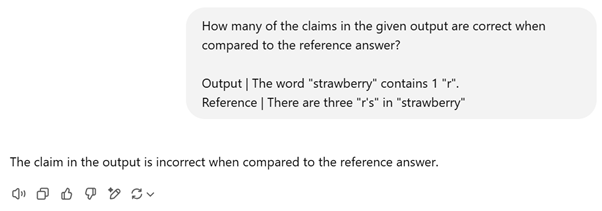
Indeed, the evaluating LLM appropriately recognizes that the answer is incorrect.
The example shows that LLMs can evaluate outputs consistently and at scale due to their ability to quickly assess several criteria. On the other hand, LLMs may struggle to understand complex, context-dependent nuances or subjective cases. Moreover, LLMs may strengthen biases within the training data and can be costly to use as an evaluation tool.
2.2. Similarity metrics for texts
When a golden reference answer is available, similarity metrics provide scalable and objective assessments of LLM performance. Famous examples are NLP metrics like BLEU and ROUGE, or more advanced embedding-based metrics like cosine similarity and BERTScore. These methods provide quantitative insights in measuring the overlap in words and sentence structure without the computational burden of running full-scale LLMs. This can be beneficial when outcomes must closely align with provided references – for example in the case of summarization or translation.
While automated metrics provide fast, repeatable, and scalable evaluations, they can fall short on interpretability and often fail to capture deeper semantic meaning and factual accuracy. As a result, they are best used in combination with human evaluation or other evaluation methods.
2.3. Human evaluation
Human evaluation provides a strong evaluation method due to its flexibility. In early stages of model development, it is used to thoroughly evaluate errors such as hallucinations, reasoning flaws, and grammar mistakes to provide insights into model limitations. As the model improves through iterative development, groups of evaluators can systematically score outputs on correctness, coherence, fluency, and relevance. To reduce workload and enable real-time human evaluation after deployment, pairwise comparison can be used. Here, two outputs are compared to determine which performs better for the same prompt. This is in fact implemented in ChatGPT.
It is recommended to use both experts as non-experts in human evaluation of your LLM. Experts can validate the model’s approach based on their expertise. On the other hand, non-experts play a crucial role in identifying unexpected behaviors and offering fresh perspectives on real-world system usage.
While human evaluation offers deep, context-aware insights and flexibility, it is resource- and time-intensive. Moreover, comparing different examiners can lead to inconsistent evaluations when they are not aligned.
2.4. Benchmarks
Lastly, there are standardized benchmarks that offer an approach to assess the general intelligence of LLMs. These benchmarks evaluate models on various capabilities, such as general knowledge (SQuAD), natural language understanding (SuperGLUE), and factual consistency (TruthfulQA). To maximize their relevance, it’s important to select benchmarks that closely align with your domain or use case. Since these benchmarks test broad abilities, they are often used to identify an initial model for prototyping. However, standardized benchmarks can provide a skewed perspective due to their lack of alignment with your specific use case.
2.5. Task specific evaluation
Depending on the task, other evaluation methods are appropriate. For instance, when testing a categorization LLM, accuracy can be measured using a predefined test set alongside a simple equality check (of the predicted category vs. actual category). Similarly, the structure of outputs can be tested by counting line-breaks; certain headers and/or the presence of certain keywords can also be checked. Although these technique are not easily generalizable across different use cases, they offer a precise and efficient way to verify model performance.
Putting things together: writing an eval to measure LLM summarization performance
Consider a scenario where you're developing an LLM-powered summarization feature designed to condense large volumes of information into three structured sections. To ensure high-quality performance, we evaluate the model for each of our five evaluation criteria. For each criterion, we identify a key question that guides the evaluation. This question helps define the precise metric needed and determines the appropriate method for calculating it.
| Criterium | Key question | Metric | How |
| Correctness | Is the summary free from hallucinations? | Number of statements in summary that can be verified based on source text | * Use an LLM-as-a-judge to check if each statement can be answered based on the source texts * Use human evaluation to verify correctness of outputs |
| Relevance | Is the summary complete? | Number of key elements present with respect to a reference guideline or golden standard summary | Cross-reference statements in summaries with LLM-as-a-judge and measure the overlap |
| Is the summary concise? | Number of irrelevant statements with respect to golden standard Length of summary | * Cross-reference statements in summaries with LLM-as-a-judge and measure the overlap * Count the number of words of generated summaries | |
| Robustness | Is the model prone to noise in the input text? | Similarity of summary generated for original text with respect to summary generated for text with noise such as typo’s and inserted irrelevant information | Compare statements with LLM-as-a-judge, or compare textual similarity with ROUGE or BERTscore |
| Instruction & restriction adherence | Does the summary comply with required structure? | Presence of three structured sections | Count number of line breaks and check presence of headers |
| Writing style | Is the writing style professional, fluent and free of grammatical errors? | Rating of tone-of-voice, fluency and grammar | * Ask LLM-as-a-judge to rate fluency and professionality and mark grammatical errors * Rate writing style with human evaluation |
| Overarching: alignment with golden standard | Do generated summaries align with golden standard summaries? | Textual similarity with respect to golden standard summary | Calculate similarity with ROUGE or BERTscore |
The table shows that the proposed evaluation strategy leverages multiple tools and combines reference-based and reference-free assessments to ensure a well-rounded analysis. And so we ensure that our summarization model is accurate, robust, and aligned with real-world needs. This multi-layered approach provides a scalable and flexible way to evaluate LLM performance in diverse applications.
Final thoughts
Managing LLM output quality is challenging, yet crucial to build robust and reliable applications. To ensure success, here are a few tips:
- Proactively define the evaluation criteria. Establish clear quality standards before model deployment to ensure a consistent assessment framework.
- Automate when feasible. While human evaluation is essential for subjective aspects, automate structured tests for efficiency and consistency.
- Leverage GenAI to broaden your evaluation. Use LLMs to generate diverse test prompts, simulate user queries, and assess robustness against variations like typos or multi-language inputs.
- Avoid reinventing the wheel. There are already various evaluation frameworks available on the internet (for instance, DeepEval). These frameworks provide structured methodologies that combine multiple evaluation techniques.
Achieving high-quality output is only the beginning. Generative AI systems require continuous oversight to address challenges that arise after deployment. User interactions can introduce unpredictable edge cases, exposing the gap between simulated scenarios and real-world usage. In addition, updates to models and datasets can impact performance, making continuous evaluation crucial to ensure long-term success. At Rewire, we specialize in helping organizations navigate the complexities of GenAI, offering expert guidance to achieve robust performance management and deployment success. Ready to take your GenAI solution to the next level? Let’s make it happen!
This article was written by Gerben Rijpkema, Data Scientist at Rewire, and Renske Zijm, Data Scientist at Rewire.

Turning Generative AI potential into bottom line impact
Our strategies enable you to harness generative AI, moving beyond marginal or tactical gains to achieve transformational success.
Explore our Generative AI servicesSteeped in history, built for the future, the new Rewire office in Amsterdam is a hub for innovation, collaboration, and impact
Rewire has taken a new step forward: a new home in Amsterdam! But this isn’t just an office. It’s a reflection of our growth, vision, and commitment to driving business impact through data & AI. With this new office, we aim to create an inspiring home away from home for our employees, and a great place to connect and collaborate with our clients and partners.
Steeped in history, built for the future
Amsterdam is a city where history and innovation coexist. Our new office embodies this spirit. Nestled in scenic Oosterpark, which dates back to 1891, and set in the beautifully restored Amstel Brewery stables from 1912, our location is a blend of tradition and modernity.
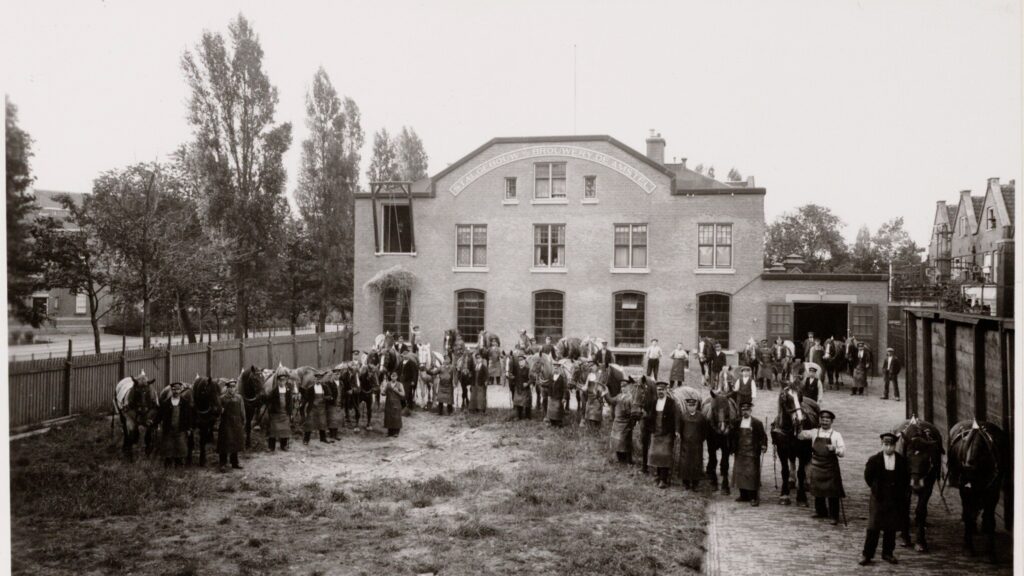

The fully refurbished Rewire office in Amsterdam once served as the stables of the Amstel brewery.
But this isn’t just about aesthetics—our presence within one of Amsterdam’s most vibrant areas is strategic. Surrounded by universities, research institutions, cultural and entertainment landmarks, we’re positioned at the crossroads of academia, industry, and creativity. Moreover, the city has established itself as a global hub for Data & AI, attracting global talent, startups, research labs, and multinational companies. Thus, we’re embedding ourselves in an environment that fosters cross-disciplinary collaboration and promotes impact-driven solutions. All in all, our new location ensures that we stay at the forefront of AI while providing an inspiring setting to work, learn, and imagine the future.
A space for collaboration & growth
At Rewire, we believe that knowledge-sharing and hands-on learning are at the core of meaningful AI adoption. That’s why our new Amsterdam office is more than just a workspace—it’s a hub for collaboration, education, and innovation.

More than just an office, it's a hub for collaboration, education, and innovation.
We’ve created dedicated spaces for GAIN’s in-person training, workshops, and AI bootcamps, reinforcing our commitment to upskilling talent and supporting the next generation of AI professionals. Whether through hands-on coding sessions, strategic AI leadership discussions, or knowledge-sharing events, this space is designed to develop the Data & AI community of tomorrow.
Beyond structured learning, we’ve designed our office to be an environment where teams can engage in deep problem-solving, collaborate on projects, and push the boundaries of what can be achieved. Our goal is to bridge the gap between research and real-world application, thus helping clients leverage AI’s full potential.


The new office includes a variety of spaces, from small quiet spaces for deep thinking to large open spaces for group work, and socializing.
Sustainability & excellence at the core
Our new office is built to the highest standards of quality and sustainability, incorporating modern energy-efficient design, eco-friendly materials, and thoughtfully designed workspaces.

Eco-friendly and energy efficient, the new office retain the fixtures of the original Amstel stables.
We’ve curated an office that balances dynamic meeting spaces, collaborative areas, and quiet zones for deep thinking—all designed to support flexibility, focus, and innovation. Whether brainstorming the next AI breakthrough or engaging in strategic discussions, our employees have a space that fosters creativity, problem-solving, and impactful decision-making.

The office is not just next to Oosterpark, one of Amsterdam's most beautiful parks. It is also home to thousands of plants.
We’re Just getting started
Our move to a new office in Amsterdam represents a new chapter in Rewire’s journey, but this is only the beginning. As we continue to expand, build, and collaborate, we look forward to engaging with the broader Data & AI community, fostering innovation, and shaping the future of AI-driven impact.
We’re excited for what’s ahead. If you’re interested in working with us, partnering on AI initiatives, or visiting our new space—contact us!

The team that made it happen.
How a low-cost, open-source approach is redefining the AI value chain and changing the reality for corporate end-users
At this point, you’ve likely heard about it: DeepSeek. Founded in 2023 by Liang Wenfeng, co-founder of the quantitative hedge fund High-Flyer, this Hangzhou-based startup is rewriting the rules of AI development with its low-cost model development, and open-source approach.
Quick recap first.
From small steps to giant leaps
There are actually two model families launched by the startup: DeepSeek-V3 and DeepSeek R1.
V3 is a Mixture-of-Experts (MoE) large language model (LLM) with 671 billion parameters. Thanks to a number of optimizations it can provide similar or better performance than other large foundational models, such as GPT-4o and Claude-3.5-Sonnet. What’s even more remarkable is that V3 was trained in around 55 days at a fraction of the cost for similar models developed in the U.S. —less than US$6 million for DeepSeek V3, compared with tens of millions, or even billions, of dollars in investments for its Western counterparts.
R1, released on January 20, 2025, is a reasoning LLM that uses innovations applied to the V3 base model to greatly improve its performance in reasoning. DeepSeek-R1 achieves performance comparable to OpenAI-o1 across math, code, and reasoning tasks. The kicker is that R1 is published under the permissive MIT license: this license allows developers worldwide to modify the model for proprietary or commercial use, which paves the way for accelerated innovation and adoption.
Less is more: reshaping the AI value chain
As other companies emulate DeepSeek’s achievements, its cost-effective approach and open-sourcing of its technology signals three upcoming shifts:
1. Lower fixed costs and increased competition. DeepSeek shows that cutting-edge LLMs no longer require sky-high investments. Users have reported running the V3 model on consumer Mac hardware and even foresee its use on devices as lightweight as a Raspberry Pi. This opens the door for more smaller players to develop their own models.
2. Higher variable costs driven by higher query costs. As reasoning models become widely available and more sophisticated, their per-query costs rise due to the energy-intensive reasoning processes. This dynamic creates new opportunities for purpose-built models – as opposed to general-purpose models like OpenAI’s ChatGPT.
3. Greater value creation down the AI value chain. As LLM infrastructure becomes a commodity (much like electricity) and companies develop competing models that dent the monopolistic power of big tech (although the latter will continue to push the boundaries with new paradigm breakthroughs), the development of solutions in the application layer – where most of the value for end-users resides – becomes much more accessible and cost-effective. Hence, we expect accelerated innovations in the application layer and the AI market to move away from “winner-takes-all” dynamics, with the emergence of diverse applications tailored to specific industries, domains, and use cases.

Transform potential into performance with GenAI
Whether you win or lose in your market may soon rely on having the best GenAI capability and the data foundations to support it. We can help you build this.
Explore our Generative AI servicesSo what’s next for corporate end-users?
Most corporate end-users will find that having a reliable and “good enough” model matters more than having the absolute best model. Advances in reasoning such as R1 could be a big step for AI agents that deal with customers and perform tasks in the workplace. If those are available more cheaply, corporate adoption and bottom lines will increase.
Taking a step back, a direct consequence of the proliferation of industry and function-specific AI solutions built in the application layer is that AI tools and capabilities will become a necessary component for any company seeking to build competitive advantage.
At Rewire, we help clients prepare themselves for this new reality by building solutions and capabilities that leverage this new “AI commodity” and turning AI potential into real-world value. To explore how we can help you harness the next wave of AI, contact us.
From customer support to complex problem-solving: exploring the core components and real-world potential of Agentic AI systems
For decades, AI has captured our imaginations with visions of autonomous systems like R2-D2 or Skynet, capable of independently navigating and solving complex challenges. While those pictures remain firmly rooted in science fiction, the emergence of Agentic AI signals an exciting step in that direction. Powered by GenAI models, these systems would improve adaptability and decision-making beyond passive interactions or narrow tasks.
Consider the example of e-commerce, where customer support is critical. Traditional chatbots handle basic inquiries, but when a question becomes more complex—such as tracking a delayed shipment or providing tailored product recommendations—the need for human intervention quickly becomes apparent. This is where GenAI agents can step in, bridging the gap between basic automation and human-level problem solving.
The promise of GenAI-driven agents isn’t about overnight industry transformation but lies in their ability to augment workflows, enhance creative processes, and tackle complex challenges with a degree of autonomy. Yet, alongside this potential come significant technological, ethical, and practical challenges that demand thoughtful exploration and development.
In this blog, we’ll delve into what sets these systems apart, examine their core components, and explore their transformative potential through real-world examples. Let’s start by listing a few examples of possible use cases for GenAI agents:
- Personal assistants that schedule meetings based on availability and send out invitations.
- Content creators that generate blog posts, social media copy, and product descriptions with speed and precision.
- Code assistants that assist developers in writing, debugging, and optimizing code.
- Healthcare assistants that analyze medical records and provide diagnostic insights.
- AI tutors that personalize learning experiences, offering quizzes and tailored feedback to students.
GenAI agents handle tasks that previously required significant human effort, freeing up valuable time and resources for strategic thinking and innovation. But what exactly are these GenAI agents, how do they work and how to design them?
Understanding the core components of GenAI agents
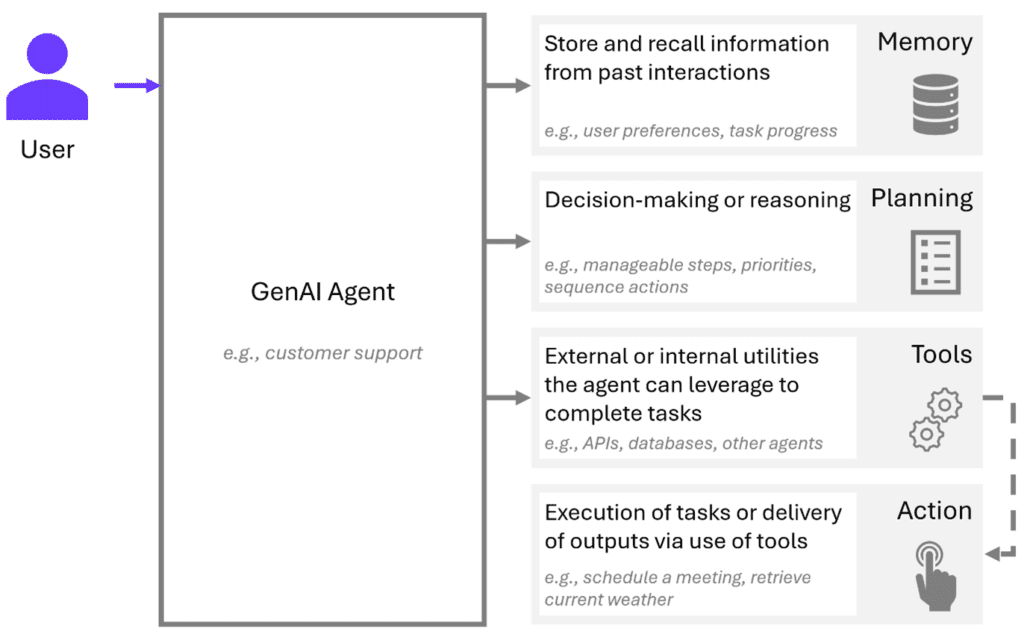
Unlike traditional chatbots, GenAI agents transcend simple text generation, captured in three core principles:
- They act autonomously. These agents are capable of taking goal-driven actions, such as querying a database or generating a report, without explicit human intervention.
- They plan and reason. Leveraging advanced reasoning capabilities, they can break down complex tasks into actionable steps.
- They integrate with tools. While LLMs are great for answering questions, GenAI agents use tools and external systems to access real-time data, perform calculations, or retrieve historical information.
What makes these capabilities possible? At the heart of every GenAI agent lies the power of GenAI models, specifically large language models (LLMs). LLMs are the engine behind the agent's ability to understand natural language, adapt to diverse tasks, and simulate reasoning. Without them, these agents couldn’t achieve the nuanced communication or versatility required for autonomy or to handle complex inputs.
But how do all the pieces come together to create such a system? To understand the full picture, we need to look beyond LLMs and examine the other key components that make GenAI agents work. Together, these components (Interface, Memory, Planning, Tools, and Action) enable the agent to process information, make decisions, and execute tasks. Let’s explore each of these building blocks in detail.
1. Interface: the bridge between you and the AI
The interface is the gateway through which users communicate with the GenAI agent. It serves as the medium for input and output, allowing users to ask questions, give commands, or provide data. Whether it’s a text-based chat, a voice command, or a more complex graphical user interface (GUI), the interface ensures the agent can understand human input and convert it into actionable data.
2. Memory: remembering what matters
Memory is what allows a GenAI agent to learn from past experiences and adapt over time. It stores both short-term and long-term information, helping the agent maintain context across interactions and deliver personalized experiences, based on past conversations and preferences.
3. Planning: charting the path to success
The planning component is the brain behind the agent’s decision-making process. This is essentially using the reasoning of an LLM to break down the problem into smaller tasks. When faced with a task or problem, the agent doesn’t just act blindly. Instead, it analyses the situation, sets goals and priorities, and devises a strategy to accomplish them. This ability to plan ensures that the agent doesn’t simply react in predefined ways, but adapts its actions for both simple and complex scenarios.
4. Tools: extending the agent’s capabilities
No GenAI agent is an island— it needs to access additional resources to solve more specialized problems. Tools can be external resources, APIs, databases, or even other specialized (GenAI) agents that the agent can use to extend its functionality. By activating tools as prompted by the GenAI agent when needed, the agent can perform tasks that go beyond its core abilities, making it more powerful and versatile.
5. Action: bringing plans to life
Once the agent has formulated a plan, it’s time to take action. The action component is where the agent moves from theory to practice, executing tasks, sending responses, or interacting with tools and external systems. It’s the moment where the GenAI agent delivers value by fulfilling its purpose, completing a task, or responding to a user request.
The core components of a GenAI agent in action
Now that we’ve broken down the core components of a GenAI agent, let’s see how they come together in a real-world scenario. Let’s get back to our customer support example and imagine a customer who is inquiring about the status of their order. Here’s how the agent seamlessly provides a thoughtful, efficient response:
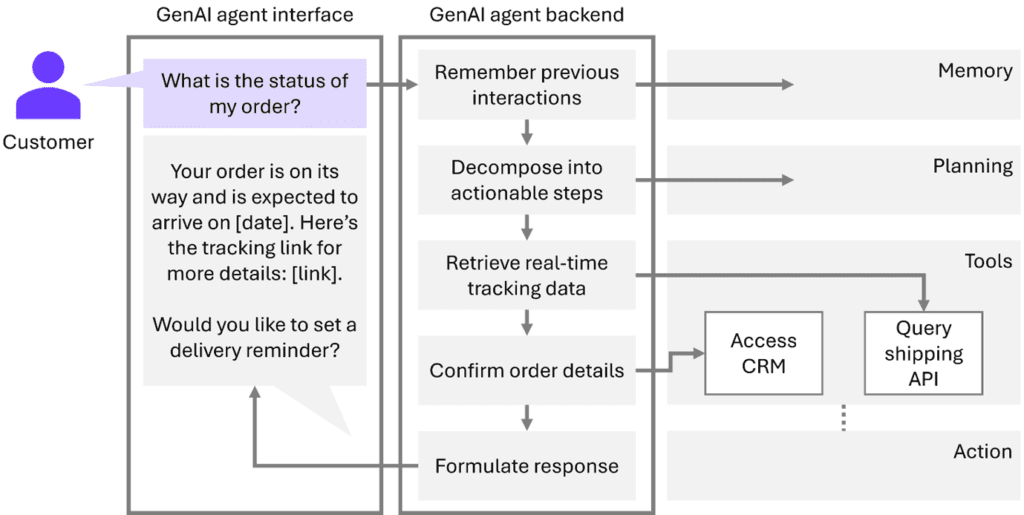
- Interface: The agent receives the customer query, "What is the status of my order?"
- Memory: The agent remembers the customer placed an order on January 15th 2025 with order ID #56789 from a previous interaction.
- Planning: The agent breaks down the task into steps: retrieve order details, check shipment status, and confirm delivery date.
- Tools: The agent accesses the DHL API with the customer’s order reference to get the most recent status update and additionally accesses CRM to confirm order details.
- Action: The agent retrieves the shipping status, namely “Out for delivery” as of January 22nd, 2025.
- Interface: The agent sends the response back to the customer: "Your order is on its way and is expected to arrive on January 22nd, 2025. Here’s the tracking link for more details: [link]. Would you like to set a delivery reminder?"
If the customer opts to set a reminder, the agent can handle this request as well by using its available tools to schedule the reminder accordingly, something that basic automation would not be able to do.
Unlocking efficiency with multi-agent systems for complex queries
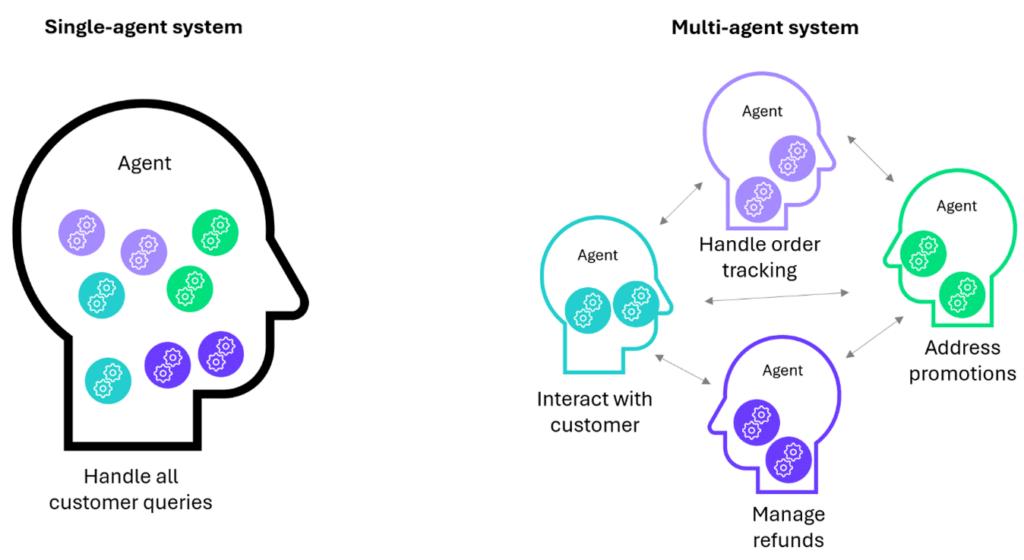
A single GenAI agent can efficiently handle straightforward queries, but real-world customer interactions often involve complex, multifaceted issues. For instance, a customer may inquire about order status while also addressing delayed shipments, refunds, and promotions—all in one conversation. Managing such tasks sequentially with one agent increases the risk of delays and errors.
This is where multi-agent systems come in. By breaking down tasks into smaller, specialized subtasks, each handled by a dedicated agent, it’s easier to ensure and track efficiency and accuracy. For example, one agent handles order tracking, another manages refunds, and a third addresses promotions.
Splitting tasks this way unlocks several benefits: simpler models can tackle reduced complexity, agents can be given specific instructions to specialize in certain areas, and parallel processing allows for approaches like majority voting to build confidence in outputs.
With specialized GenAI agents working together, businesses can scale support for complex queries while maintaining speed and precision. This multi-agent approach outperforms traditional customer service, offering a more efficient and accurate solution than escalating issues to human agents.
What is needed to design GenAI agents?
Whether you’re automating customer support, enhancing business processes, or revolutionizing healthcare, building effective GenAI agents is a strategic endeavor that requires expertise across multiple disciplines.
At the core of building a GenAI agent is the integration of key components that enable its functionality and adaptability:
- Data engineering. The foundation of any GenAI agent is its ability to access and process data from multiple sources. This includes integrating APIs, databases, and real-time data streams, ensuring the agent can interact with the world outside its own environment. Effective data engineering enables an agent to access up-to-date information, making it dynamic and capable of handling a variety of tasks.
- Prompt engineering. For a large language model to perform effectively in a specific domain, it must be tailored through prompt engineering. This involves crafting the right inputs to guide the agent’s responses and behavior. Whether it’s automating customer inquiries or analyzing medical data, domain-specific prompts ensure that the agent’s actions are relevant, accurate, and efficient.
- Experimentation. Designing workflows for GenAI agents requires balancing autonomy with accuracy. During experimentation, developers must refine the agent’s decision-making process, ensuring it can handle complex tasks autonomously while maintaining the precision needed to deliver valuable results. This iterative process of testing and optimizing is key to developing agents that operate efficiently in real-world scenarios.
- Ethics and governance. With the immense potential of GenAI agents comes the responsibility to ensure they are used ethically. This means designing systems that protect sensitive data, comply with regulations, and operate transparently. Ensuring ethical behavior isn’t just about compliance—it’s about building trust with users and maintaining accountability in AI-driven processes.
Transform potential into performance with GenAI
Whether you win or lose in your market may soon rely on having the best GenAI capability and the data foundations to support it. We can help you build this.
Explore our Generative AI servicesChallenges and pitfalls with GenAI agents
While GenAI agents hold tremendous potential, there are challenges that need careful consideration:
- Complexity in multi-agent systems. Coordinating multiple specialized agents can introduce complexity, especially in ensuring seamless communication and task execution.
- Cost vs. benefit. With resource-intensive models, balancing the sophistication of GenAI agents with the cost of deployment is crucial.
- Data privacy and security. As GenAI agents require access to vast data and tools, ensuring the protection of sensitive information becomes a top priority.
- Ethical and regulatory considerations. Bias in training data, dilemmas around autonomous decision-making, and challenges in adhering to legal and industry-specific standards create significant risks. Deploying these agents responsibly requires addressing ethical concerns while navigating complex regulatory frameworks to ensure compliance.
- Performance management. Implementing agent systems effectively requires overcoming the complexity of monitoring and optimizing their performance. From breaking down reasoning steps to preparing systems and data for smooth access, managing the performance of these agents as they scale remains a significant hurdle.
Unlocking the future of GenAI agents with insights and discoveries ahead - stay tuned!
GenAI agents represent an exciting shift in how we approach problem-solving and human-computer interaction. With their promise to reason, plan, and execute tasks autonomously, these agents have the potential to tackle even the most complex workflows. As we continue our exploration of these systems, our focus will remain on understanding both their immense promise and the challenges they present.
In the coming weeks, we will delve deeper into the areas where GenAI agents excel, where they struggle, and what can be done to enhance their real-world effectiveness. We invite you to follow along with us as we share our experiments, findings, and practical insights from this ongoing journey. Stay tuned for our next blog post, where we will explore the evolving landscape of GenAI agents, along with the valuable lessons we have learned through experimentation.
This article was written by Mirte Pruppers, Data Scientist, Phebe Langens, Data Scientist, and Simon Koolstra, Principal at Rewire.