Why every C-level executive needs a vision for AI-native organisations
Foreword
The writing is on the wall: AI technology is accelerating faster than enterprise adoption can keep up. The industry has woken up to the fact that deployment — not model capability — is becoming the real bottleneck to scalable, transformational impact. The narrative is shifting from model improvement to the AI diffusion gap. OpenAI, Google and Anthropic are moving downstream through JVs, alliances and service partnerships to de-bottleneck implementation and pave the way for enterprise value creation.
In abstract terms, this diffusion challenge is familiar: new technology is being applied to old paradigms. History is full of examples where technologies only captured their full potential once the context around them was redesigned. The shift to AI-native organisations has only just begun, but its first contours are becoming clear.
AI is not simply another technology layer added to the existing organisation. It is a new operational substrate for how decisions are made, knowledge is applied, and work gets executed. The implication is not merely that people will work differently with AI software, but how organisations are redesigned around intelligent systems.
Most modern enterprises were built to compensate for human limitations: limited memory, limited context, limited coordination capacity, and limited cognitive bandwidth. That is why work is fragmented into departments, management layers, workflows, meetings, approvals, handovers and systems of record.
AI changes the economics of cognition itself. For the first time, we can build systems that reason across vast amounts of information, coordinate activities in real time, learn from feedback, and execute workflows end-to-end. This does not simply improve existing processes. It challenges the assumptions on which those processes were built. Much of what we traditionally classified as “knowledge work” — analysis, coordination, judgement, synthesis — is no longer uniquely human but rapidly becoming automatable at scale.
That is why many AI initiatives fail to create meaningful impact. Companies insert AI into organisational structures, infrastructure and systems that are fundamentally incompatible with AI’s full potential. A smarter chatbot here. A copilot there. Ten fragmented optimisations inside an unchanged system architecture.
The real productivity leap does not come from ten steps becoming twenty percent faster. The organisations that lead in the coming decade will be those that redesign their operating model around intelligent systems first. We call these organisations AI-native.
This paper describes what that future looks like: why AI-native organisations emerge, how intelligent systems reshape organisational design, why knowledge and decision-making become part of the digital backbone, and why competitive advantage increasingly depends on feedback loops, orchestration, and the continuous evolution of operational intelligence.
The transition does not begin with a massive transformation programme. It begins by redesigning one core process end-to-end around AI — and learning from deployment.
Start small. But think radically.
Wouter Huygen, CEO Rewire
|
▶
|
Each section below can be expanded. Click a heading to read more. |
Suddenly AI is everywhere
And yet, for the vast majority of organisations, successfully designing, building and scaling AI solutions remains a complex challenge. Data is fragmented, organisations are complex, and a lot of the work relies on the tacit knowledge internalized by employees. Real bottom-line results often take a long time to materialise.
Most organisations start their AI journey pragmatically: they want more efficiency and scalability relative to the current way of working. Think of a large call centre that needs to handle more information requests quickly, or an insurer that wants to clear a large claims backlog. All legitimate use cases — but the real possibilities of AI are far more disruptive. More and more Rewire clients see this too. Instead of looking for ways to make the old way of working slightly more efficient, they ask a far more ambitious question: “How can we completely rebuild that way of working around the power of AI technology?”
The real possibilities of AI are far more disruptive than a faster version of the old way of working.
AI-native: letting go of the human lens
Until the end of the nineteenth century, factories were built around a single central steam engine, with a complicated system of shafts, belts and gears to distribute power to all parts of the production line. The electric motor initially only replaced that central power source, resulting in a relatively modest increase in productivity.
Only when manufacturers equipped each component with its own electric motor could they completely reorganise their entire factory floor. Workflows became more linear, logistics more efficient, working conditions improved dramatically. Thus the invention of the electric motor produced a significant rise in productivity only decades later - once the entire organisation and infrastructure had been redesigned around it.
Birth of the AI-native organisation
AI systems are rapidly expanding their ability to assess information, make decisions, evaluate results and plan ahead. This, in turn, creates the opportunity to reorganise core processes and entire organisations around the power of AI. This is the prelude to the birth of the AI-native organisation.
The vast majority of the work done in offices, factories, warehouses and other workplaces consists of repeated patterns: the ‘assembly line of the knowledge work era’. Current AI technology can already perform much of that work faster than humans. Humans are, after all, not optimised for repetitive information work. This is why organisations will inevitably emerge where AI becomes central to all decisions and execution.
Organisations will inevitably emerge where AI becomes central to all decisions and execution.
Instead of a complex organisational chart with management layers, functions and silos, a much flatter organisation will emerge, one that operates many times more efficiently and responds faster to new developments. But getting there requires courage and a visionary mindset from C-level decision-makers. One where they can no longer view their company through a human lens.
Knowledge and decision-making as the digital backbone
The number of AI pilots increased spectacularly last year. More and more organisations are so enthusiastic about the possibilities of AI that every department starts experimenting on its own. This is currently creating a real proliferation of AI pilots. Unfortunately, the real AI experts within an organisation are usually scarce. Moreover, scaling up pilots requires large investments at many different levels (data, technology, organisation, and so on). It is therefore usually far more productive to focus efforts on a few strategic projects with a clearly described ROI.
In its most disruptive form, a strategic AI pilot can become an entirely new entity alongside the existing business. This form of greenfield incubation delivers results particularly when it is possible to work entirely around existing (legacy) technology. To generate momentum and results more quickly, at Rewire we tend to opt for ‘reinvention from the inside out’: select a core process, redesign it end-to-end as an intelligent system, and scale from there.
Digitising knowledge and decision-making
For example, we are currently redesigning the fault-handling processes involving a 1,400-employee call centre for a major Dutch telecom player. They had operated for years via a deterministic step-by-step plan: employees worked through a fixed series of questions and checks to identify the problem. One of the many inefficiencies: employees who were paid based on call duration were too quick to send out a technician or a new modem. The vast majority of returned modems still worked perfectly.
An AI assistant currently supports these employees to diagnose faults. The system reads the network directly and simultaneously guides the employee through the conversation with the customer. This not only significantly reduces call time, but also the number of technician visits and hardware replacements, while customer satisfaction increases significantly. In the longer term, this system optimisation — in which instead of an individual link being improved the entire chain has been redesigned around the optimal outcome — will replace employees entirely.
In the new call centre situation, knowledge and decision-making all become part of the digital system.
Previously, the digital system of the call centre served primarily for execution and recording, while people did the decision-making. In the newly optimized system, knowledge, information and decision-making all become part of the digital system. These AI systems consist of four layers:
The four layers of a state-of-the-art AI system
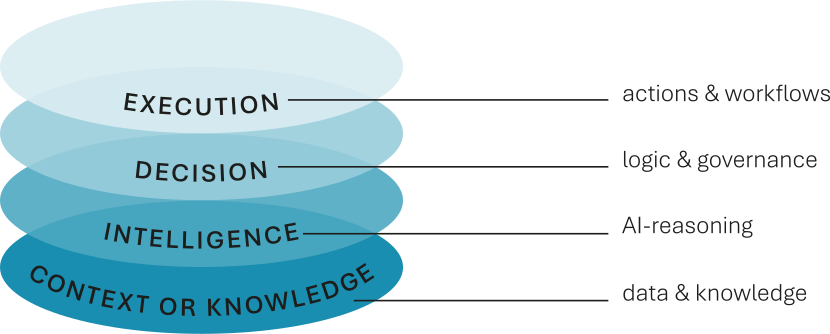
Context or Knowledge Layer Everything starts here. This layer is the knowledge base on which the entire system runs, and usually the most underestimated. The real bottleneck in AI implementations lies rarely in the model, but in the quality and accessibility of the underlying information, and the way in which this information is structured and fed to the AI model. This information encompasses structured and unstructured data as well as the implicit expertise that resides in employees’ heads and has never been written down. Ontologies (more on this later) play a major role here.
Intelligence Layer The reasoning engine of the system. This is where the AI agents live. They convert raw information into understanding: large language models, specialist models and reasoning engines that work step by step through complex issues. They do not reason on the basis of fixed rules, but on the basis of pattern recognition. They can therefore respond in situations they have never ‘experienced’ before. In modern AI architectures, this layer increasingly consists of multiple specialised models working together, each good at a specific task, directed by an overarching orchestration system.
Decision Layer The layer that converts reasoning into decision. This is where the decision logic of the organisation lies: thresholds, responsibilities and the boundaries of autonomy. What does the system handle independently, what requires human judgement, and when is escalation triggered? This layer underpins a fundamental shift: systems handle what is clear and repeatable; people focus on what is nuanced or risky. Which decisions the system may make is therefore not a technical question, but a strategic and legal one.
Execution Layer Where the system interacts with the world. Decisions are converted into concrete actions: customer communication, system updates, supplier contact, instructions to other agents. Unlike classic process automation, AI agents/systems here do not work on the basis of a fixed script, but on the basis of a goal: they recognise exceptions and take alternative paths. As the layers above become more sophisticated, people focus more on designing, monitoring and further developing the system as a whole.
From ontologies to self-improving decision systems
Organising knowledge in a way that machines understand it is one of the most important AI challenges of the moment. Neglecting this aspect greatly increases the chance that AI models draw the wrong conclusions – the dreaded ‘hallucinations’. The solution comes in the form of specialised databases. These so-called knowledge graphs organise data from a large number of (un)structured sources in a way that is optimally accessible to AI models. These knowledge graphs, in turn, are derived from ontologies.
Ontologies (popularised by AI software pioneer Palantir) are the definitions of the objects that exist, the relationships between them, and the rules governing those relationships. Taking the previous example of the fault-handling process at a telecom company, this would include the definitions and properties of a ‘customer’, and how the concept of ‘customer’ relates to other concepts such as ‘data subscription’, ‘internet connection’ and ‘faults’.
Self-improving decision systems
Self-improving decision systems not only record what happens in an organisation, but also why. On the basis of what information are decisions made, what options were considered in previous decisions, and what was the ultimate result of that decision? This decision history itself serves to update all relevant components in the system. This distinguishes them from traditional knowledge systems: they’re not a static archive of facts, but a self-improving system that converts organisational knowledge into ever-sharper judgement.
The three layers of self-improving decision systems.
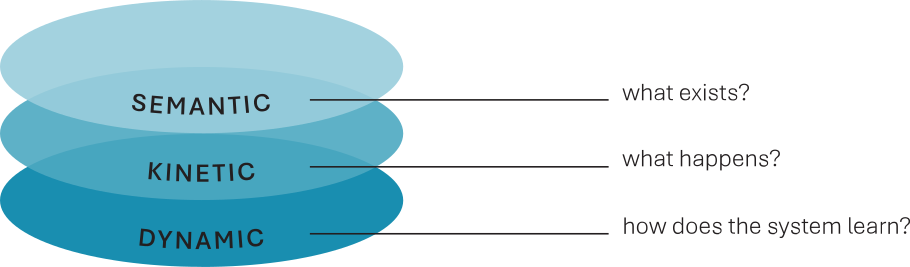
Layer 1 – Semantic: what exists? The semantic layer defines all relevant objects and their mutual relationships: what is a customer? An internet connection? A fault? In practice, departments and systems often use different definitions. The semantic layer creates one shared, structured model. This creates the common language that AI needs to reason reliably. Without this foundation, an LLM produces answers that are internally consistent but factually incorrect for your specific context.
Layer 2 – Kinetic: what happens? The kinetic layer adds processes and actions: which steps are taken? Which decisions made? Which actions are possible? This is the layer that enables autonomously operating AI systems (such as AI agents) to advise, and, crucially, to act: initiate an action, prepare a decision, signal an exception. Many AI implementations stall at the advisory stage. The kinetic layer is the bridge between advice and execution.
Layer 3 – Dynamic: how does the system learn? The dynamic layer describes how the system learns from new information and optimises itself on the basis of feedback. It’s the difference between a system that becomes outdated and one that grows with the organisation. Competitive advantage lies not in the (rapidly commoditising) model itself, but in the quality of the feedback loops. Organisations that set this up well build a system that gets a little better every day.
Impressive figures from financial frontrunners
The result is a ‘self-learning digital backbone’ that increasingly weaves itself into the core of the business. The way people collaborate within that company changes structurally, just as it did with earlier digital transformations. Because these systems automate the way of working end-to-end, there is less need for all kinds of separate departments or silos.
The required specialist knowledge resides in the Context (or Knowledge) layer and in the AI models. The role of human employees is therefore becoming that of a supervisor. They use their knowledge and experience not to carry out the work, but to continuously optimise the processes done by AI systems. A single specialist now manages what was previously the work of a team. We see this development prominently in financial services, for several good reasons:
- At its core, the financial services industry is a digital information business.
- Checking rules (compliance) is highly automatable.
- Many decisions are rule-driven, and therefore automatable.
- The combination of inefficiencies and high margins creates an opening for more efficient competitors.
A good example of a financial services provider that has made enormous impact with its AI-native approach is Ant Financial. Thanks to its ecosystem built around e-commerce giant Alibaba and the Alipay payment platform, it has access to vast amounts of customer data: from credit scores and transaction behaviour, to payment patterns and reputation scores. The AI system of Ant Financial’s fully automated MYBANK uses this data for, among others, its groundbreaking and highly successful ‘3-1-0’ model.
After a 3-minute intake, every applicant hears within 1 second and 0 human intervention whether they will receive a loan. A significant portion of applicants were previously turned away by traditional banks due to insufficient collateral or credit history. Thanks to this AI-driven credit provision, MYBANK has now financed 53 million SMEs, without any physical branches being involved. The following figures show which AI-native processes Ant Financial developed for its ecosystem:
- The MYBANK system analyses more than 3,000 variables per applicant. This results in a default rate of just 0.38 percent, compared to an industry average of 1.9 percent.
- Ant Financial’s insurance division operates a ‘2-1-2’ model: claims assessment in 2 minutes, decision in 1 second, payout within 2 hours.
- In MYBANK’s first year (2015), the share of self-service in customer service rose from 60 to 94 percent. Two years later, the quality of AI-driven customer service exceeded that of human employees for the first time.
- Thanks to AI agent Antom, web shops connect to Ant’s payment network within minutes. Competitors often take 5 to 10 working days.
MYBANK shows what happens when an organisation organises itself around the latest possibilities of AI technology.
Speed of learning as the new competitive advantage
MYBANK is a compelling example of an AI-native financial institution. Every core process — from credit assessment and risk management to customer service was designed from the ground up around AI. It shows what happens when an organisation no longer organises itself around human capabilities, but around the latest capabilities of AI technology. In doing so, some of the human limitations largely disappear:
- A person can only process a limited amount of information. And so we break work into manageable tasks, distribute them across departments, and record handover moments in processes and systems. Every handover is a concession to our cognitive bandwidth.
- A person needs focus and cannot know everything about everything. And so we organise expertise in silos — legal, finance, marketing, operations, risk — and build coordination layers to make those silos talk to each other. Management is the glue that holds those specialisms together.
- A person works relatively slowly, irregularly and unpredictably. And so we phase decision-making into weekly meetings, monthly reports and quarterly cycles, with batches, queues and escalation paths — because real-time handling simply lies beyond our reach.
- A person is expensive, scarce and inflexible. And so we strive for standardisation: one process for all customers, one work instruction for all employees, one decision tree for all cases. Personalisation at scale is economically unfeasible as long as people do the work.
- Transferring human expertise is complex and time-consuming. And so we invest heavily in training, procedures and manuals to capture knowledge — while an important part of all organisational knowledge resides mostly in the heads of experienced employees.
MYBANK shows what happens when an organisation organises itself around the latest possibilities of AI technology.
The architecture of every modern organisation is in fact an optimisation to compensate for the above limitations. It’s a structure that has been developed over the years to allow a group of people working inefficiently to work towards a particular goal as quickly and efficiently as possible.
C-level executives who want to unlock the full power of AI must let go of this human-centric lens. Instead, they must develop a vision for rebuilding their organisation with an AI-centric lens: identify a process to reshape — and rebuild it with AI from the ground up.
In practice, however, we see pilots with marginal results: a slightly more efficient version of the way of working that they are supposed to replace. The scarce AI expertise within an organisation becomes fragmented across dozens of small experiments that individually lack the critical mass to fundamentally change anything. By all means start small, but make sure that the thinking is radical.
New process with AI as the starting point
Take the handling process of the aforementioned call centre, which consists of a fixed series of manual steps. The customer calls in, an employee identifies the customer and consults the customer history, classifies the question, searches for the answer in a knowledge base, implements the solution in the source system, and records the conversation for follow-up. Each of those steps requires attention, context and manual work.
The reflex of many organisations and suppliers is to develop point solutions for one of those steps. A smarter IVR that routes customers better. Speech recognition that transcribes the conversation. An AI assistant that whispers suggestions to the agent from the knowledge base. Each component is now slightly faster. But at most this results in a process that still consists of all individual steps — only slightly more efficiently.
The AI-native way of working is fundamentally different. Instead of looking at how each one of the ten steps can run slightly faster, we turn the question on its head: if we were to redesign this entire process today, with current AI capabilities as the starting point, what would it look like?
The answer is not a series of ten slightly smarter steps, but one coherent intelligent system. The customer asks their question, and the system does the rest in one continuous flow: it recognises the customer, reads the relevant systems directly, diagnoses on the basis of real-time data and measurements from the network, understands the context of the question, consults the required knowledge, makes the decision, takes action, communicates the result, and records everything for future learning. What were previously ten handovers between people, screens and systems is now one integrated action.
Why the four layers of AI systems underpin AI-native organisations
The individual steps do not disappear because they are automated, but because they no longer need to exist separately. They were primarily an organisational solution for the human limitations we described earlier: the necessity to break up, distribute, coordinate and transfer work. An intelligent system that unites the four layers (context, intelligence, decision and execution) does not know these limitations. Because the silos disappear, AI systems can at any moment, in real time, incorporate the complete organisational context into decision-making. Existing management processes thereby become superfluous.
This is where the real productivity leap lies. Not in ten steps that each run twenty percent faster, but in a reinvented process reduced to a single step. Not in more efficient coordination, but in the disappearance of the need for coordination. That is what we mean by Rewiring: not adding AI to the existing way of working, but rethinking the way of working itself on the basis of what AI makes possible.
Without a top-down mandate, no transformation
This approach cannot emerge bottom up. Redesigning a core process as an intelligent system touches departmental boundaries, established roles, existing IT investments and ingrained ways of working. The resistance is rarely technical, but almost always organisational. Without a disruptive vision at C-level, and without the explicit willingness to break through existing structures, every ambition stagnates. This is why AI-native is a governance issue, not an IT issue.
The role of the C-level executive changes fundamentally as a result. Not ‘how do we implement AI as efficiently as possible in our existing organisation?’, but: ‘which part of our business core are we going to reinvent first — and do we dare to bear the consequences of that?’
AI-native is not a technology choice, but an organisational design. It does not call for more AI on top of existing processes, but for rebuilding processes around AI. And not for one giant leap forward, but for a targeted, radical redesign of one strategic part of the organisation — and from there the next, and the next.
The executives who set this movement in motion now are not building a more efficient version of yesterday’s organisation. They are building the organisation of tomorrow. That is why every C-level executive today must have a vision for AI-native organisations.
Not in three years, but now.

|
Partner and CEO Wouter Huygen What if we can use AI to multiply human creativity? We can. Wouter has extensive experience leading large-scale data and AI transformations at multinationals, primarily in technology-intensive sectors such as the telecom and semiconductor industries. Before joining Rewire in 2015, Wouter was a strategy consultant at Booz & Co. He obtained an MBA from INSEAD (cum laude) and an MSc Systems & Control Engineering from TU Delft (also cum laude). |
Building your AI capabilities, end-to-end
Our strategies elevate the impact of AI from marginal or tactical to transformational successes.
Let's talk!Key points from a webinar on grounding and governing AI agents at scale.
Many companies can come up with an AI agent demo. Fewer can put it in production.
In conversations with senior leaders at companies across a range of industries – from finance to retail and industrial manufacturing - we keep hearing a version of the same frustration: the demos work brilliantly, the stakeholders are excited, and then something stalls on the way to scale. But the agents behave strangely in edge cases. Governance becomes a bottleneck. Maintenance costs balloon as each new use case requires its own bespoke configuration.
We ran a webinar recently to dig into exactly this challenge. What follows are the core ideas from that session and our view on what enterprises need to do differently if they are serious about deploying agentic AI at scale.
Confidence is rising faster than readiness
With today’s front-end tooling and LLM capabilities, almost any team can produce something that looks impressive in a meeting room. That is genuinely useful: it generates buy-in, surfaces requirements, and tests appetite. But it creates a dangerous illusion: that scaling will be just as easy.
It isn’t.
The hard part is industrialisation. Specifically, it comes down to two challenges that most enterprises are not yet solving at the level they need to:
- Grounding agents by giving them the right context to reason reliably on company-specific knowledge
- Governance guardrails that ensure that agents act within defined boundaries, with full traceability of what they did and why
Both are solvable. But solving them at scale requires a fundamentally different approach than what most teams are currently taking.
Why system prompting doesn’t scale
When organisations build their first agent, they typically invest heavily in the system prompt. They write down the agent’s role, its constraints, company-specific policies, definitions, access rules — sometimes running to tens of pages of YAML configuration. It works, for that agent.
Then they build a second agent. And a third. Each one gets its own bespoke prompt, its own embedded knowledge, its own version of the truth.
Think of it this way: imagine you needed to onboard 500 new employees every Monday. Would you rewrite the onboarding manual from scratch for each one? Of course not — you would create one set of materials that captures how the company works, and distribute it consistently. The same logic applies to agents. Once you are running not five but fifty or five hundred specialised agents — which is where the leading organisations are heading — the per-agent system-prompting model collapses under its own weight. It’s inefficient, inconsistent, and almost impossible to keep current as policies evolve.
The alternative is to treat company knowledge as a shared, governed asset that agents draw from at runtime — rather than knowledge that gets duplicated and embedded inside each individual agent.
The knowledge graph as a thin, navigable layer
This is where graph-based knowledge systems come in. Not as a data migration project, and not as a replacement for your existing data stack — but as a thin contextual layer that sits above it.
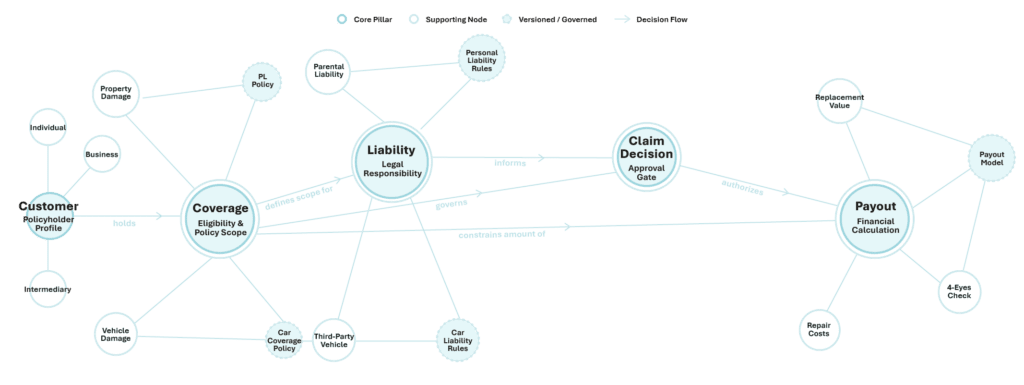
In a demo we built for the insurance sector, we showed two very different claim types — a car insurance claim and a personal liability claim — both reasoning over the same underlying knowledge graph. The graph itself does not store vast amounts of data. It stores the relationships between concepts: coverage, liability, payout thresholds, policy versions, ownership. When a claim arrives, the agent traverses the graph to identify which nodes are relevant, then fetches the underlying data from wherever it actually lives.
The result is a system where shared knowledge is defined once, versioned, governed, and reused across use cases. When a policy changes, you update it in one place. Every agent that depends on that policy gets the updated version automatically.
Governance is not optional infrastructure
Governance is where most agentic AI initiatives will either compound or collapse.
The governance question for agents is essentially: who said what, why, and were they even allowed to? Without clear answers to those questions at every step, you are not running a governed system — you are running a risk.
There are two dimensions worth separating here.
- Access management becomes your decision boundary. Traditional identity and access management was a back-end control layer — who can log in, who can view which reports. In an agentic enterprise, it becomes something more active: the mechanism that determines, in real time, whether an agent is authorised to take a specific action on a specific piece of data. In our insurance demo, a claim below a certain payout threshold could be approved automatically. One above that threshold triggered a human-in-the-loop approval flow — and critically, the two approvers were granted access to only the specific documents and context needed for that decision, only for the duration of that approval. Access on the fly, not standing access. That distinction matters enormously as agents begin acting on behalf of humans at scale.
- Audit trails are not just a compliance requirement — they are the foundation for improving the system. When an agent makes a decision you didn’t expect, you need to be able to trace back exactly what knowledge it drew on, which version of which policy it referenced, what reasoning it applied, and what human actions (if any) were taken. Without that traceability, you cannot distinguish between a bad policy, a bad prompt, and a bad decision by a human approver. With it, you can close the loop.
You are not starting from zero
One of the most important points we want to make is this: the road to governed, grounded agentic AI is not greenfield.
Most enterprises we work with have spent the last several years doing the work of data management — data products, data contracts, data mesh thinking, semantic alignment across source systems. That work is not wasted. It is, in fact, the foundation. Raw data, once structured and contextualised, becomes information. Information, connected across domains in graph-like structures, becomes knowledge. And knowledge, made available to agents at runtime, is what enables them to reason reliably.
Five principles for getting governance right from the start
Based on what we have seen work — and what we have seen fail — we offer five principles for building knowledge governance into your agentic systems from day one.
1. Govern knowledge, not just data. Data governance covers facts. Knowledge governance covers meaning, rules, and provenance. Both need to be explicit, structured, and traceable. If your agents rely on knowledge that can change without a formal update pipeline, the system is only as reliable as its weakest human process.
2. Design for both humans and machines. Every interface, standard, and format you adopt should be interpretable by both. We strongly favour human-machine-readable formats such as YAML precisely because they create a single source of truth that both can rely on.
3. Build knowledge as an enterprise layer, not an application layer. The temptation, especially early, is to embed knowledge directly into the application you are building. Resist it. If you store semantic definitions in four different application-specific layers, you have four copies of the truth, and coordination costs that grow with each new use case.
4. Make governance the fastest path to production, not the slowest. Governance has a reputation for slowing things down. That reputation is often earned — but it does not have to be. If the governance mechanisms are cumbersome, engineering teams will route around them. Design for speed and compliance simultaneously, and adoption follows naturally.
5. Build the audit trail first. Traceability is not something to retrofit. The moment you have a full audit trail of agent reasoning, knowledge versions, access decisions, and human approvals, you have the feedback loop that allows the system to improve. Without it, every incident is a black box.
What this means for you, today
Agentic AI is no longer hypothetical. Major enterprises across insurance, telecom, retail, and manufacturing are already running agentic systems in production. The organisations that will move fastest are not those with the biggest models — they are those with the most codified, governed, reusable knowledge.
The competitive advantage is not the agent. It is the knowledge the agent can reliably draw on.
This webinar and article were produced by Rewire's Helen Rijkes (Partner), Freek Gulden (Principal), Nanne van 't Klooster (Principal), and Job van Zijl (Senior Data engineer).
Building your AI capabilities, end-to-end
Our strategies elevate the impact of AI from marginal or tactical to transformational successes.
Explore our AI servicesThe race to building competitive advantage just took an interesting turn. Here is what you need to know.
What is model distillation?
In chemistry, distillation is a purification process where a liquid mixture is heated until components with different boiling points separate. The result is often a more concentrated, refined substance. This elegant concentration technique has been used for centuries to create everything from perfumes to whiskey, preserving essential qualities while removing unnecessary bulk.
Model distillation in AI follows a remarkably similar principle; knowledge is extracted from a large and complex AI model (the “teacher”) and transferred to a smaller, more efficient model (the “student”). At its core, model distillation is about teaching the student to act like the teacher. Instead of training a small model with traditionally labeled data, response-based knowledge distillation allows the student model to mimic the intelligence of the teacher (i.e., output token probability distributions, for the data scientists among us).
The result is a refined, lightweight model that captures a concentrated essence of its larger counterpart's capabilities within its domain of expertise.
Why model distillation is everywhere
While DeepSeek did not invent model distillation, their breakthrough in early 2025, which we discussed before, catapulted cost efficiency for GenAI models into the frontstage, proving that smaller teams with limited resources could compete at the cutting edge of AI development.
The latest generation Large Language Models (LLMs) like GPT-4.5, DeepSeek V3, and Claude 3.7 are incredibly powerful—but also incredibly expensive to run. Model distillation offers the process of training a smaller model to mimic a larger one, delivering near state-of-the-art performance in a narrow domain at a fraction of the cost.
DeepSeek was a game changer in the pricing of large scale models. Model distillation extends beyond that: it enables AI capabilities where even the cheapest full-scale LLMs are too expensive or impractical to run.
For example, researchers from the University of Washington created their own reasoning model in merely 26 minutes for less than $50. InHand Networks successfully distilled models on their edge AI computers to provide low-power real-time inference capabilities. This revolution has forced even industry giants like OpenAI to reconsider their closed-source approach.
Why it is a game-changer for businesses
The value of model distillation extends far beyond reducing expenses—it unlocks new possibilities for AI implementation that were not feasible previously. Here's how it's changing the game:
✅Better unit economics. Running small, distilled models requires significantly less computational resources, translating directly to lower operational costs for high-volume AI applications.
✅ Enhanced inference speed. Smaller models process data more quickly, leading to faster response times and improved user experience in time-sensitive applications.
✅ Near state-of-the-art performance. For well-defined use cases, a distilled model can perform remarkably close to full-size LLMs while being more efficient and cost-effective.
✅ Smaller bottleneck on data. The requirement on your data shifts from curating and labeling large datasets, to a smaller curated set of examples with teacher-generated answers, significantly reducing annotation costs and time.
Not a silver bullet: the downsides you should consider
Model distillation is not without hurdles. Here’s what you need to plan for:
❌ Upfront development cost. Building and training your own distilled model takes time and effort from experts in your team.
❌ Teacher performance limitation. The small model can only be as good as the large model it learns from. Furthermore, some large proprietary model providers like OpenAI and Anthropic put restrictions on the output of their models, hindering their use for model distillation.
❌ No automatic updates. When improved foundation models are released, you need to repeat the process of distillation to get access to these improvements in distilled format.
Model distillation in action: where it works best
Distillation works great when you need cost-effective, scalable AI in a controlled environment. Good use cases include:
🔹 Edge devices & on-device solutions. Frontier models do not fit on consumer hardware or smaller edge devices. (Edge devices—e.g., phones, sensors, or cameras—process data locally and on the spot instead of sending it to a distant data center.) If low-latency or portability is a requirement, you may want to embed the required intelligence in a smaller package.
🔹 Personalized content generation at scale. Think online learning platforms that generate exercises tailored to their students’ needs, or marketing tools that generate personalized e-mail content.
🔹 Domain-specific chatbots. Customer support bots trained for highly specific industries without relying on expensive full-scale models for all interactions.
🔹Specialized parts of agentic workflows. Agents use notoriously many tokens. Hence, splitting your solution up in specialized modules with distilled models can reduce costs and latency significantly, especially at scale.
However, don’t use model distillation for deep research or complex, open-ended reasoning tasks. If your AI needs to push the boundaries of intelligence or perform highly creative problem-solving, a distilled model won’t cut it; inherently, it will remain inferior to its teacher.
The bottom line: does distillation fit your business needs?
Model distillation is transforming from an academic idea into a competitive advantage for businesses. It democratizes advanced AI capabilities while dramatically reducing costs. For businesses facing the dual pressures of innovation and efficiency, distillation offers a middle ground: near state-of-the-art performance without the steep price tag.
Just be mindful that it’s not a silver bullet. Many use cases will still require full-scale LLMs, which offer the benefit of broader and more general knowledge and capabilities.
If your AI roadmap has well-defined use cases in a specific domain that can afford a short-term investment for long-term cost benefits, it may well be worth it to explore this approach.

Turning Generative AI potential into bottom line impact
Our strategies enable you to harness generative AI, moving beyond marginal or tactical gains to achieve transformational success.
Explore our Generative AI servicesThis article was written by Jacco Broere, Data & AI Engineer at Rewire and Simon Koolstra, Principal at Rewire.
Unlocking true intelligence with memory, strategic planning, and transparent performance management
The rise of intelligent AI agents marks a shift from traditional task automation toward more adaptive, decision-making systems. While many AI-powered workflows today rely on predefined rules and deterministic processes, true agentic AI goes beyond fixed automation—it incorporates memory, reasoning, and self-improvement to adapt and autonomously achieve specific goals.
The previous agentic AI blog post explained the building blocks (memory, planning, tools and actions), use cases, and potential for autonomy. It positioned AI agents not just as tools for automating repetitive tasks but as systems capable of enhancing workflow efficiency and tackling complex problems with some degree of independent decision-making. In this blog post, we explore how these agents can be seamlessly integrated into real-world scenarios, striking a balance between cognitive science theory and the practical realities of human-agent interaction, with a particular focus on the memory and planning building blocks, alongside the addition of performance management.
Moving from models to real-world AI agents
Scaling AI agents presents challenges. While they can improve efficiency, their success depends on integration with existing systems. Use cases like personal assistants and content generators demonstrate clear value, whereas others struggle with reliability and adaptability.
Current LLM-based workflow automation relies on knowledge—whether through large reasoning models or knowledge bases. However, these agents often lack persistent memory, meaning they re-solve the same issues repeatedly. Without storing and leveraging past experiences, they remain reactive rather than truly intelligent. To bridge this gap, AI agents need:
- Memory – Retaining and applying past experiences.
- Ability to plan – Setting goals, adapting strategies, and managing complexity.
- Transparent performance management – Ensuring alignment, oversight, and trust.
These elements go beyond the building blocks of tools and actions, which have already been widely discussed in AI agent design. Here we focus on memory, planning, and performance management, as they represent critical design choices to move toward AI agents that are not just reactive task automators, but intelligent, adaptable decision-makers capable of handling more sophisticated tasks in real-world scenarios. Let’s start by exploring what intelligence in that sense even means.
Memory: the key to true intelligence
True intelligence goes beyond automation. An AI agent must not only process information but also learn from past experiences to improve over time. Without memory, an AI agent would remain static, unable to adapt or evolve. By integrating memory, reasoning, and learning, an intelligent AI agent moves beyond simply performing predefined tasks. In our previous blog post on AI agents, we explained that memory, planning, tools and actions are the building blocks of agents. Now, let's examine how memory plays a crucial role in enhancing an AI agent's capabilities. In cognitive science, memory is divided into:
- Semantic memory – A structured database of facts, rules, and language that provides foundational knowledge.
- Episodic memory – Past experiences that inform future decisions and allow for adaptation.
The interplay between semantic and episodic memory enables self-improvement: experiences enrich knowledge, while knowledge structures experiences. When agents lack episodic memory, they struggle with contextual awareness and must rely solely on predefined rules or external prompting to function effectively. To obtain intelligent agents, episodic memory is therefore crucial. By organizing past interactions into meaningful units (through chunking), agents can recall relevant solutions, compare them to new situations, and refine their approach. This form of memory actively supports an agent’s ability to reflect on past actions and outcomes.
To illustrate this, let's consider an example from supply chain management, as depicted in the image below. An AI agent that tracks delivery data, inventory, and demand can improve logistics by learning from past experiences. If the agent identifies patterns, such as delays during certain weather conditions or peak seasons, it can proactively adjust shipping schedules and notify relevant stakeholders. Without memory, the agent would simply repeat tasks without optimizing them, leading to inefficiencies and missed opportunities for improvement.
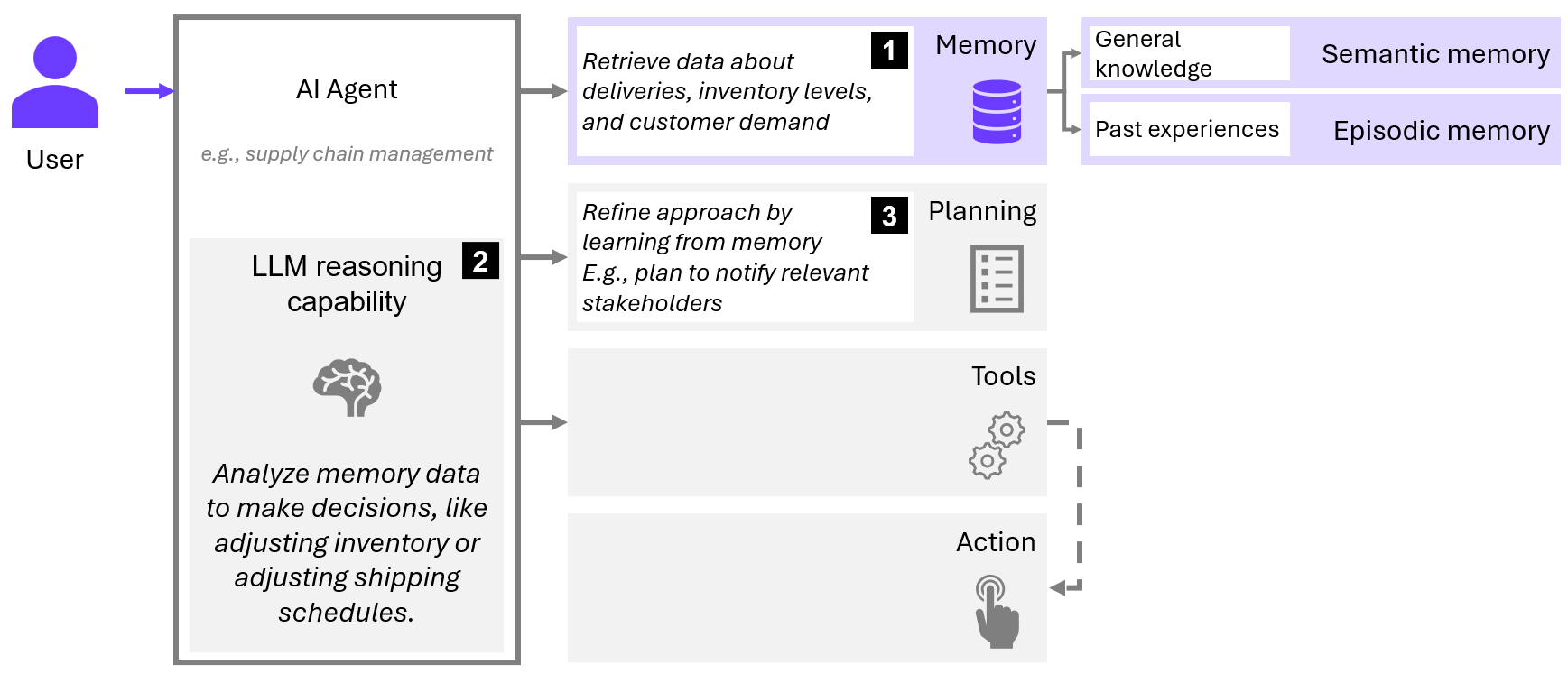
Figure 1 - Memory in AI Agents - An example from supply chain management
Ability to plan: the foundation for autonomous decision-making
Intelligent AI agents must dynamically plan and break complex problems into manageable tasks—mirroring the analytical nature of the human mind. Unlike rule-based automation, these agents should be able to assess different strategies, evaluate potential outcomes, and adjust their approach based on real-time feedback. Planning allows an agent to remain flexible, ensuring it can pivot when conditions change rather than blindly following predefined sequences.
LLMs serve as the reasoning engines of AI agents, showcasing increasingly advanced cognitive abilities. However, they struggle with long-term memory and sustained focus—much like the human mind under information overload. This limitation poses challenges in designing AI agents that must retain context across extended interactions or tackle complex problem-solving tasks.
A critical design question is whether an agent should retain plans internally or offload them to an external tool. Keeping plans within an LLM provides full information access but may be limited by context constraints. For example, an AI managing a real-time chat-based customer support system could benefit from internal memory to dynamically adapt to an ongoing conversation, keeping track of the customer's previous questions and preferences without relying on external systems. This allows the agent to provide personalized responses without the delay of querying an external database. On the other hand, external tools lighten the cognitive load but can introduce rigidity if not well-integrated. For instance, an AI-powered weather application might be better off using an external tool to retrieve up-to-date weather data rather than relying on its internal model, which could become outdated or too complex to manage. This allows the system to focus on processing and presenting the information without overloading its internal resources. A balanced approach ensures adaptability without overloading the agent’s working memory. Ultimately, the necessity of such a tool depends on the LLM's ability to retrieve, retain, and adjust information—an advanced reasoning model might even eliminate the need for external tools.
For example, an AI-powered financial advisor might need to balance long-term investment strategies with short-term market fluctuations. If it relies too heavily on immediate context, it might make impulsive decisions based on temporary trends. On the other hand, if it solely adheres to a rigid external planning framework, it might fail to adapt to new opportunities. The ideal approach blends both—leveraging structured knowledge while maintaining the ability to dynamically reassess and adjust strategies.
Transparent performance management: balancing efficiency and trust
Human-AI agent interaction is shaped by the trade-off between efficiency and trust: the more autonomous an AI agent becomes, the more it can streamline operations and reduce human workload—yet the less transparent its decision-making may feel. In scenarios where tasks are low-risk and repetitive, full automation makes sense as errors have minimal impact, and efficiency gains outweigh the downsides. However, in high-stakes environments like financial trading or medical diagnosis, the costs of a wrong decision are simply too high. Transparent performance management is thus essential.
The challenge is that AI agents, while improving, are still fallible, inheriting issues like hallucinations and biases from LLMs. AI must operate within defined trust thresholds—where automation is reliable enough to act independently yet remains accountable. Rather than requiring continuous human oversight, performance management should focus on designing mechanisms that allow AI agents to function autonomously while ensuring reliability. This involves self-monitoring, self-correction, and explainability.
Mechanisms like agent self-critique mitigate these issues by enabling agents to evaluate their own decisions before execution. Also known as LLM-as-a-judge, self-critique involves sending both input and output to a separate LLM entity that is unaware of the entire agentic workflow, assessing whether the response logically follows from the input. For instance, an LLM can check its output for consistency by sending both its input and response to a separate validation model, which then determines whether the response aligns with the provided information. This process helps catch hallucinations, biases, and inconsistencies before decisions are finalized, improving the reliability of autonomous AI agents.
In the early stages of AI agent deployment, human experts play a crucial role in shaping and refining performance management processes. However, as these agents evolve, the goal is to reduce direct human intervention while maintaining oversight through structured performance metrics. Instead of requiring constant check-ins, AI agents should be designed to self-monitor and adapt, ensuring alignment with objectives without excessive human involvement. By incorporating mechanisms for self-assessment, AI agents can achieve greater autonomy while maintaining accountability. The ultimate aim is to develop fully autonomous agents that balance efficiency with transparency—operating independently while ensuring performance remains reliable.
For example, consider an AI agent managing IT system maintenance in a large enterprise. Such an agent monitors server performance, security threats, and software updates. Instead of relying on human intervention for every decision, it can autonomously detect anomalies, apply minor patches, and optimize system configurations based on historical performance data. However, major decisions—such as deploying a company-wide software update—may still require validation through transparent reporting mechanisms. If the AI agent consistently demonstrates accuracy in its assessments and risk predictions, human involvement can gradually decrease, ensuring both operational efficiency and system integrity.

Transform potential into performance with GenAI
Whether you win or lose in your market may soon rely on having the best GenAI capability and the data foundations to support it. We can help you build this.
Explore our Generative AI servicesWhat’s next for AI agents?
AI agents are evolving beyond simple automation. To become truly intelligent, they must adapt, plan, and learn from experience. Without memory, an agent is static. Without planning, it lacks direction. Without transparent performance management, it risks unreliability.
By integrating memory, planning, and performance management, AI agents can move beyond task execution toward strategic problem-solving. Future AI will not merely automate processes but will actively contribute to decision-making, helping organizations navigate complexity with greater precision and efficiency.
The future belongs to AI that doesn’t just execute tasks but remembers, adapts, and improves. An agent without intelligence is merely automation with an attitude.
Sources
Greenberg DL, Verfaellie M. "Interdependence of episodic and semantic memory: evidence from neuropsychology." J Int Neuropsychol Soc. 2010;16(5):748-753. doi:10.1017/S1355617710000676. Link.
"Does AI Remember? The Role of Memory in Agentic Workflows." (2025) Link.
"RULER: What's the Real Context Size of Your Long-Context Language Models?" (2024). arXiv:2404.06654
This article was written by Gijs Smeets, Data Scientist at Rewire and Mirte Pruppers, Data Scientist at Rewire.
An introduction to the world of LLM output quality evaluation: the challenges and how to overcome them in a structured manner
Perhaps you’ve been experimenting with GenAI for some time now, but how do you determine when the output quality of your Large Language Model (LLM) is sufficient for deployment? Of course, your solution needs to meet its objectives and deliver reliable results. But how can you evaluate this effectively?
In contrast to LLMs, assessing machine learning models is often a relatively straightforward process: metrics like Area Under the Curve for classification or Mean Absolute Percentage Error for regression give you valuable insights in the performance of your model. On the other hand, evaluating LLMs is another ball game, since GenAI generates unstructured, subjective outputs – in the form of texts, images, or videos - that often lack a definitive "correct" answer. This means that you’re not just assessing whether the model produces accurate outputs; you also need to consider, for example, relevance and writing style.
For many LLM-based solutions (except those with very specific tasks, like text translation), the LLM is just one piece of the puzzle. LLM-based systems are typically complex, since they often involve multi-step pipelines, such as retrieval-augmented generation (RAG) or agent-based decision systems, where each component has its own dependencies and performance considerations.
In addition, system performance (latency, cost, scalability) and responsible GenAI (bias, fairness, safety) add more layers of complexity. LLMs operate in ever-changing contexts, interacting with evolving data, APIs, and user queries. Maintaining consistent performance requires constant monitoring and adaptation.
With so many moving parts, figuring out where to start can feel overwhelming. In this article, we’ll purposefully over-simplify things by answering the question: “How can you evaluate the quality of your LLM output?”. First, we explain what areas you should consider in the evaluation of the output. Then, we’ll discuss the methods needed to evaluate output. Finally, to make it concrete, we bring everything together in an example.
What are the evaluation criteria of LLM output quality?
High-quality outputs build trust and improve user experience, while poor-quality responses can mislead users and foster misinformation. The start of building an evaluation (eval) is to start with the end-goal of the model. The next step is to define the quality criteria to be evaluated. Typically these are:
- Correctness: Are the claims generated by the model factually accurate?
- Relevance: Is the information relevant to the given prompt? Is all required information provided -by the end user, or in the training data- to adequately offer an answer to the given prompt?
- Robustness: Does the model consistently handle variations and challenges in input, such as typos, unfamiliar question formulations, or types of prompts that the model was not specifically instructed for?
- Instruction and restriction adherence: Does the model comply with predefined restrictions or is it easily manipulated to jailbreak the rules?
- Writing style: Does the tone, grammar, and phrasing align with the intended audience and use case?
How to test the quality of LLM outputs?
Now that we’ve identified what to test, let’s explore how to test. A structured approach involves defining clear requirements for each evaluation criterion listed in the previous section. There are two aspects to this: references to steer your LLM towards the desired output and the methods to test LLM output quality.
1. References for evaluation
In LLM-based solutions, the desired output is referred to as the golden standard, which contain reference answers for a set of input prompts. Moreover, you can provide task-specific guidelines such as model restrictions and evaluate how well the solution adheres to those guidelines.
While using a golden standard and task-specific guidelines can effectively guide your model towards the desired direction, it often requires a significant time investment and may not always be feasible. Alternatively, performance can also be assessed through open-ended evaluation. For example, you can use another LLM to assess relevance, execute generated code to verify its validity, or test the model on an intelligence benchmark.
2. Methods for assessing output quality
Selecting the right method depends on factors like scalability, interpretability, and the evaluation requirement being measured. In this section we explore several methods, and assess their strengths and limitations.
2.1. LLM-as-a-judge
An LLM isn’t just a text generator—it can also assess the outputs of another LLM. By assessing outputs against predefined criteria, LLMs provide an automated and scalable evaluation method.
Let’s demonstrate this with an example. For example, ask the famous question, "How many r's are in strawberry?" to ChatGPT's 4o mini model. It responds with, "The word 'strawberry' contains 1 'r'.", which is obviously incorrect. With the LLM-as-a-judge method, we would like the evaluating LLM (in this case, also 4o mini) to recognize and flag this mistake. In this example, there is a golden reference answer “There are three 'r’s' in 'strawberry'.”, which can be used to evaluate the correctness of the answer.
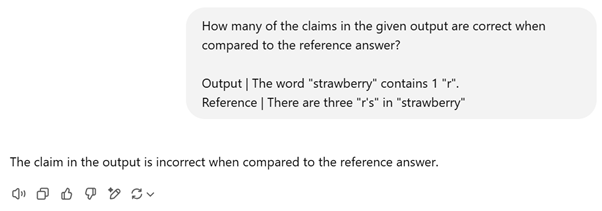
Indeed, the evaluating LLM appropriately recognizes that the answer is incorrect.
The example shows that LLMs can evaluate outputs consistently and at scale due to their ability to quickly assess several criteria. On the other hand, LLMs may struggle to understand complex, context-dependent nuances or subjective cases. Moreover, LLMs may strengthen biases within the training data and can be costly to use as an evaluation tool.
2.2. Similarity metrics for texts
When a golden reference answer is available, similarity metrics provide scalable and objective assessments of LLM performance. Famous examples are NLP metrics like BLEU and ROUGE, or more advanced embedding-based metrics like cosine similarity and BERTScore. These methods provide quantitative insights in measuring the overlap in words and sentence structure without the computational burden of running full-scale LLMs. This can be beneficial when outcomes must closely align with provided references – for example in the case of summarization or translation.
While automated metrics provide fast, repeatable, and scalable evaluations, they can fall short on interpretability and often fail to capture deeper semantic meaning and factual accuracy. As a result, they are best used in combination with human evaluation or other evaluation methods.
2.3. Human evaluation
Human evaluation provides a strong evaluation method due to its flexibility. In early stages of model development, it is used to thoroughly evaluate errors such as hallucinations, reasoning flaws, and grammar mistakes to provide insights into model limitations. As the model improves through iterative development, groups of evaluators can systematically score outputs on correctness, coherence, fluency, and relevance. To reduce workload and enable real-time human evaluation after deployment, pairwise comparison can be used. Here, two outputs are compared to determine which performs better for the same prompt. This is in fact implemented in ChatGPT.
It is recommended to use both experts as non-experts in human evaluation of your LLM. Experts can validate the model’s approach based on their expertise. On the other hand, non-experts play a crucial role in identifying unexpected behaviors and offering fresh perspectives on real-world system usage.
While human evaluation offers deep, context-aware insights and flexibility, it is resource- and time-intensive. Moreover, comparing different examiners can lead to inconsistent evaluations when they are not aligned.
2.4. Benchmarks
Lastly, there are standardized benchmarks that offer an approach to assess the general intelligence of LLMs. These benchmarks evaluate models on various capabilities, such as general knowledge (SQuAD), natural language understanding (SuperGLUE), and factual consistency (TruthfulQA). To maximize their relevance, it’s important to select benchmarks that closely align with your domain or use case. Since these benchmarks test broad abilities, they are often used to identify an initial model for prototyping. However, standardized benchmarks can provide a skewed perspective due to their lack of alignment with your specific use case.
2.5. Task specific evaluation
Depending on the task, other evaluation methods are appropriate. For instance, when testing a categorization LLM, accuracy can be measured using a predefined test set alongside a simple equality check (of the predicted category vs. actual category). Similarly, the structure of outputs can be tested by counting line-breaks; certain headers and/or the presence of certain keywords can also be checked. Although these technique are not easily generalizable across different use cases, they offer a precise and efficient way to verify model performance.
Putting things together: writing an eval to measure LLM summarization performance
Consider a scenario where you're developing an LLM-powered summarization feature designed to condense large volumes of information into three structured sections. To ensure high-quality performance, we evaluate the model for each of our five evaluation criteria. For each criterion, we identify a key question that guides the evaluation. This question helps define the precise metric needed and determines the appropriate method for calculating it.
| Criterium | Key question | Metric | How |
| Correctness | Is the summary free from hallucinations? | Number of statements in summary that can be verified based on source text | * Use an LLM-as-a-judge to check if each statement can be answered based on the source texts * Use human evaluation to verify correctness of outputs |
| Relevance | Is the summary complete? | Number of key elements present with respect to a reference guideline or golden standard summary | Cross-reference statements in summaries with LLM-as-a-judge and measure the overlap |
| Is the summary concise? | Number of irrelevant statements with respect to golden standard Length of summary | * Cross-reference statements in summaries with LLM-as-a-judge and measure the overlap * Count the number of words of generated summaries | |
| Robustness | Is the model prone to noise in the input text? | Similarity of summary generated for original text with respect to summary generated for text with noise such as typo’s and inserted irrelevant information | Compare statements with LLM-as-a-judge, or compare textual similarity with ROUGE or BERTscore |
| Instruction & restriction adherence | Does the summary comply with required structure? | Presence of three structured sections | Count number of line breaks and check presence of headers |
| Writing style | Is the writing style professional, fluent and free of grammatical errors? | Rating of tone-of-voice, fluency and grammar | * Ask LLM-as-a-judge to rate fluency and professionality and mark grammatical errors * Rate writing style with human evaluation |
| Overarching: alignment with golden standard | Do generated summaries align with golden standard summaries? | Textual similarity with respect to golden standard summary | Calculate similarity with ROUGE or BERTscore |
The table shows that the proposed evaluation strategy leverages multiple tools and combines reference-based and reference-free assessments to ensure a well-rounded analysis. And so we ensure that our summarization model is accurate, robust, and aligned with real-world needs. This multi-layered approach provides a scalable and flexible way to evaluate LLM performance in diverse applications.
Final thoughts
Managing LLM output quality is challenging, yet crucial to build robust and reliable applications. To ensure success, here are a few tips:
- Proactively define the evaluation criteria. Establish clear quality standards before model deployment to ensure a consistent assessment framework.
- Automate when feasible. While human evaluation is essential for subjective aspects, automate structured tests for efficiency and consistency.
- Leverage GenAI to broaden your evaluation. Use LLMs to generate diverse test prompts, simulate user queries, and assess robustness against variations like typos or multi-language inputs.
- Avoid reinventing the wheel. There are already various evaluation frameworks available on the internet (for instance, DeepEval). These frameworks provide structured methodologies that combine multiple evaluation techniques.
Achieving high-quality output is only the beginning. Generative AI systems require continuous oversight to address challenges that arise after deployment. User interactions can introduce unpredictable edge cases, exposing the gap between simulated scenarios and real-world usage. In addition, updates to models and datasets can impact performance, making continuous evaluation crucial to ensure long-term success. At Rewire, we specialize in helping organizations navigate the complexities of GenAI, offering expert guidance to achieve robust performance management and deployment success. Ready to take your GenAI solution to the next level? Let’s make it happen!
This article was written by Gerben Rijpkema, Data Scientist at Rewire, and Renske Zijm, Data Scientist at Rewire.
Turning Generative AI potential into bottom line impact
Our strategies enable you to harness generative AI, moving beyond marginal or tactical gains to achieve transformational success.
Explore our Generative AI servicesSteeped in history, built for the future, the new Rewire office in Amsterdam is a hub for innovation, collaboration, and impact
Rewire has taken a new step forward: a new home in Amsterdam! But this isn’t just an office. It’s a reflection of our growth, vision, and commitment to driving business impact through data & AI. With this new office, we aim to create an inspiring home away from home for our employees, and a great place to connect and collaborate with our clients and partners.
Steeped in history, built for the future
Amsterdam is a city where history and innovation coexist. Our new office embodies this spirit. Nestled in scenic Oosterpark, which dates back to 1891, and set in the beautifully restored Amstel Brewery stables from 1912, our location is a blend of tradition and modernity.
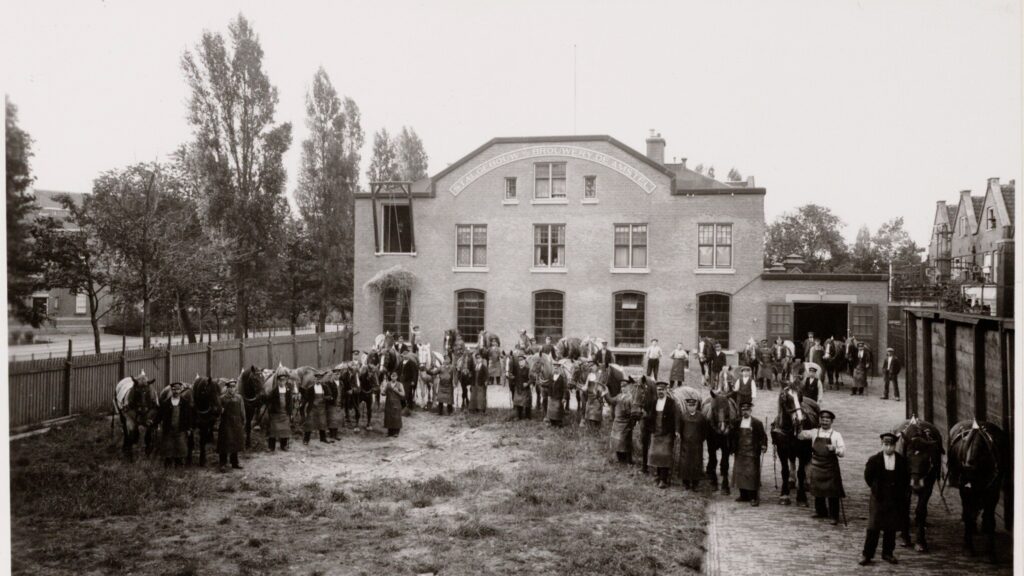

The fully refurbished Rewire office in Amsterdam once served as the stables of the Amstel brewery.
But this isn’t just about aesthetics—our presence within one of Amsterdam’s most vibrant areas is strategic. Surrounded by universities, research institutions, cultural and entertainment landmarks, we’re positioned at the crossroads of academia, industry, and creativity. Moreover, the city has established itself as a global hub for Data & AI, attracting global talent, startups, research labs, and multinational companies. Thus, we’re embedding ourselves in an environment that fosters cross-disciplinary collaboration and promotes impact-driven solutions. All in all, our new location ensures that we stay at the forefront of AI while providing an inspiring setting to work, learn, and imagine the future.
A space for collaboration & growth
At Rewire, we believe that knowledge-sharing and hands-on learning are at the core of meaningful AI adoption. That’s why our new Amsterdam office is more than just a workspace—it’s a hub for collaboration, education, and innovation.

More than just an office, it's a hub for collaboration, education, and innovation.
We’ve created dedicated spaces for GAIN’s in-person training, workshops, and AI bootcamps, reinforcing our commitment to upskilling talent and supporting the next generation of AI professionals. Whether through hands-on coding sessions, strategic AI leadership discussions, or knowledge-sharing events, this space is designed to develop the Data & AI community of tomorrow.
Beyond structured learning, we’ve designed our office to be an environment where teams can engage in deep problem-solving, collaborate on projects, and push the boundaries of what can be achieved. Our goal is to bridge the gap between research and real-world application, thus helping clients leverage AI’s full potential.


The new office includes a variety of spaces, from small quiet spaces for deep thinking to large open spaces for group work, and socializing.
Sustainability & excellence at the core
Our new office is built to the highest standards of quality and sustainability, incorporating modern energy-efficient design, eco-friendly materials, and thoughtfully designed workspaces.

Eco-friendly and energy efficient, the new office retain the fixtures of the original Amstel stables.
We’ve curated an office that balances dynamic meeting spaces, collaborative areas, and quiet zones for deep thinking—all designed to support flexibility, focus, and innovation. Whether brainstorming the next AI breakthrough or engaging in strategic discussions, our employees have a space that fosters creativity, problem-solving, and impactful decision-making.

The office is not just next to Oosterpark, one of Amsterdam's most beautiful parks. It is also home to thousands of plants.
We’re Just getting started
Our move to a new office in Amsterdam represents a new chapter in Rewire’s journey, but this is only the beginning. As we continue to expand, build, and collaborate, we look forward to engaging with the broader Data & AI community, fostering innovation, and shaping the future of AI-driven impact.
We’re excited for what’s ahead. If you’re interested in working with us, partnering on AI initiatives, or visiting our new space—contact us!

The team that made it happen.
How a low-cost, open-source approach is redefining the AI value chain and changing the reality for corporate end-users
At this point, you’ve likely heard about it: DeepSeek. Founded in 2023 by Liang Wenfeng, co-founder of the quantitative hedge fund High-Flyer, this Hangzhou-based startup is rewriting the rules of AI development with its low-cost model development, and open-source approach.
Quick recap first.
From small steps to giant leaps
There are actually two model families launched by the startup: DeepSeek-V3 and DeepSeek R1.
V3 is a Mixture-of-Experts (MoE) large language model (LLM) with 671 billion parameters. Thanks to a number of optimizations it can provide similar or better performance than other large foundational models, such as GPT-4o and Claude-3.5-Sonnet. What’s even more remarkable is that V3 was trained in around 55 days at a fraction of the cost for similar models developed in the U.S. —less than US$6 million for DeepSeek V3, compared with tens of millions, or even billions, of dollars in investments for its Western counterparts.
R1, released on January 20, 2025, is a reasoning LLM that uses innovations applied to the V3 base model to greatly improve its performance in reasoning. DeepSeek-R1 achieves performance comparable to OpenAI-o1 across math, code, and reasoning tasks. The kicker is that R1 is published under the permissive MIT license: this license allows developers worldwide to modify the model for proprietary or commercial use, which paves the way for accelerated innovation and adoption.
Less is more: reshaping the AI value chain
As other companies emulate DeepSeek’s achievements, its cost-effective approach and open-sourcing of its technology signals three upcoming shifts:
1. Lower fixed costs and increased competition. DeepSeek shows that cutting-edge LLMs no longer require sky-high investments. Users have reported running the V3 model on consumer Mac hardware and even foresee its use on devices as lightweight as a Raspberry Pi. This opens the door for more smaller players to develop their own models.
2. Higher variable costs driven by higher query costs. As reasoning models become widely available and more sophisticated, their per-query costs rise due to the energy-intensive reasoning processes. This dynamic creates new opportunities for purpose-built models – as opposed to general-purpose models like OpenAI’s ChatGPT.
3. Greater value creation down the AI value chain. As LLM infrastructure becomes a commodity (much like electricity) and companies develop competing models that dent the monopolistic power of big tech (although the latter will continue to push the boundaries with new paradigm breakthroughs), the development of solutions in the application layer – where most of the value for end-users resides – becomes much more accessible and cost-effective. Hence, we expect accelerated innovations in the application layer and the AI market to move away from “winner-takes-all” dynamics, with the emergence of diverse applications tailored to specific industries, domains, and use cases.
Transform potential into performance with GenAI
Whether you win or lose in your market may soon rely on having the best GenAI capability and the data foundations to support it. We can help you build this.
Explore our Generative AI servicesSo what’s next for corporate end-users?
Most corporate end-users will find that having a reliable and “good enough” model matters more than having the absolute best model. Advances in reasoning such as R1 could be a big step for AI agents that deal with customers and perform tasks in the workplace. If those are available more cheaply, corporate adoption and bottom lines will increase.
Taking a step back, a direct consequence of the proliferation of industry and function-specific AI solutions built in the application layer is that AI tools and capabilities will become a necessary component for any company seeking to build competitive advantage.
At Rewire, we help clients prepare themselves for this new reality by building solutions and capabilities that leverage this new “AI commodity” and turning AI potential into real-world value. To explore how we can help you harness the next wave of AI, contact us.
From customer support to complex problem-solving: exploring the core components and real-world potential of Agentic AI systems
For decades, AI has captured our imaginations with visions of autonomous systems like R2-D2 or Skynet, capable of independently navigating and solving complex challenges. While those pictures remain firmly rooted in science fiction, the emergence of Agentic AI signals an exciting step in that direction. Powered by GenAI models, these systems would improve adaptability and decision-making beyond passive interactions or narrow tasks.
Consider the example of e-commerce, where customer support is critical. Traditional chatbots handle basic inquiries, but when a question becomes more complex—such as tracking a delayed shipment or providing tailored product recommendations—the need for human intervention quickly becomes apparent. This is where GenAI agents can step in, bridging the gap between basic automation and human-level problem solving.
The promise of GenAI-driven agents isn’t about overnight industry transformation but lies in their ability to augment workflows, enhance creative processes, and tackle complex challenges with a degree of autonomy. Yet, alongside this potential come significant technological, ethical, and practical challenges that demand thoughtful exploration and development.
In this blog, we’ll delve into what sets these systems apart, examine their core components, and explore their transformative potential through real-world examples. Let’s start by listing a few examples of possible use cases for GenAI agents:
- Personal assistants that schedule meetings based on availability and send out invitations.
- Content creators that generate blog posts, social media copy, and product descriptions with speed and precision.
- Code assistants that assist developers in writing, debugging, and optimizing code.
- Healthcare assistants that analyze medical records and provide diagnostic insights.
- AI tutors that personalize learning experiences, offering quizzes and tailored feedback to students.
GenAI agents handle tasks that previously required significant human effort, freeing up valuable time and resources for strategic thinking and innovation. But what exactly are these GenAI agents, how do they work and how to design them?
Understanding the core components of GenAI agents
Unlike traditional chatbots, GenAI agents transcend simple text generation, captured in three core principles:
- They act autonomously. These agents are capable of taking goal-driven actions, such as querying a database or generating a report, without explicit human intervention.
- They plan and reason. Leveraging advanced reasoning capabilities, they can break down complex tasks into actionable steps.
- They integrate with tools. While LLMs are great for answering questions, GenAI agents use tools and external systems to access real-time data, perform calculations, or retrieve historical information.
What makes these capabilities possible? At the heart of every GenAI agent lies the power of GenAI models, specifically large language models (LLMs). LLMs are the engine behind the agent's ability to understand natural language, adapt to diverse tasks, and simulate reasoning. Without them, these agents couldn’t achieve the nuanced communication or versatility required for autonomy or to handle complex inputs.
But how do all the pieces come together to create such a system? To understand the full picture, we need to look beyond LLMs and examine the other key components that make GenAI agents work. Together, these components (Interface, Memory, Planning, Tools, and Action) enable the agent to process information, make decisions, and execute tasks. Let’s explore each of these building blocks in detail.
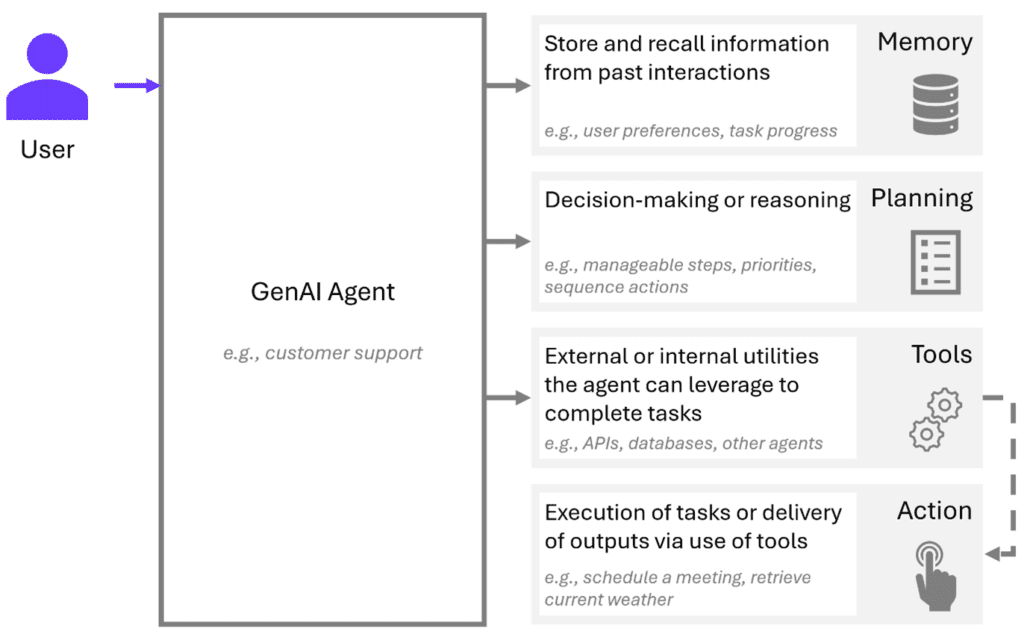
1. Interface: the bridge between you and the AI
The interface is the gateway through which users communicate with the GenAI agent. It serves as the medium for input and output, allowing users to ask questions, give commands, or provide data. Whether it’s a text-based chat, a voice command, or a more complex graphical user interface (GUI), the interface ensures the agent can understand human input and convert it into actionable data.
2. Memory: remembering what matters
Memory is what allows a GenAI agent to learn from past experiences and adapt over time. It stores both short-term and long-term information, helping the agent maintain context across interactions and deliver personalized experiences, based on past conversations and preferences.
3. Planning: charting the path to success
The planning component is the brain behind the agent’s decision-making process. This is essentially using the reasoning of an LLM to break down the problem into smaller tasks. When faced with a task or problem, the agent doesn’t just act blindly. Instead, it analyses the situation, sets goals and priorities, and devises a strategy to accomplish them. This ability to plan ensures that the agent doesn’t simply react in predefined ways, but adapts its actions for both simple and complex scenarios.
4. Tools: extending the agent’s capabilities
No GenAI agent is an island— it needs to access additional resources to solve more specialized problems. Tools can be external resources, APIs, databases, or even other specialized (GenAI) agents that the agent can use to extend its functionality. By activating tools as prompted by the GenAI agent when needed, the agent can perform tasks that go beyond its core abilities, making it more powerful and versatile.
5. Action: bringing plans to life
Once the agent has formulated a plan, it’s time to take action. The action component is where the agent moves from theory to practice, executing tasks, sending responses, or interacting with tools and external systems. It’s the moment where the GenAI agent delivers value by fulfilling its purpose, completing a task, or responding to a user request.
The core components of a GenAI agent in action
Now that we’ve broken down the core components of a GenAI agent, let’s see how they come together in a real-world scenario. Let’s get back to our customer support example and imagine a customer who is inquiring about the status of their order. Here’s how the agent seamlessly provides a thoughtful, efficient response:
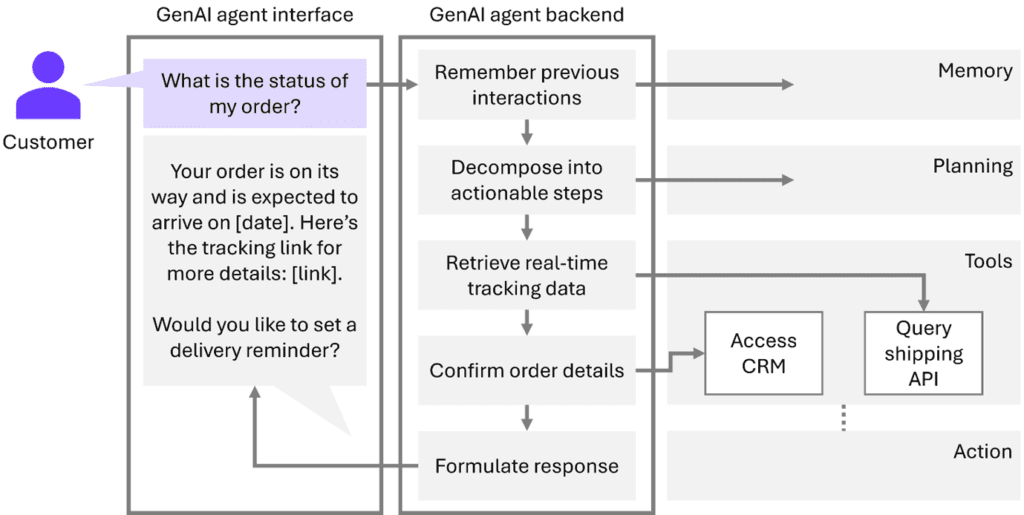
- Interface: The agent receives the customer query, "What is the status of my order?"
- Memory: The agent remembers the customer placed an order on January 15th 2025 with order ID #56789 from a previous interaction.
- Planning: The agent breaks down the task into steps: retrieve order details, check shipment status, and confirm delivery date.
- Tools: The agent accesses the DHL API with the customer’s order reference to get the most recent status update and additionally accesses CRM to confirm order details.
- Action: The agent retrieves the shipping status, namely “Out for delivery” as of January 22nd, 2025.
- Interface: The agent sends the response back to the customer: "Your order is on its way and is expected to arrive on January 22nd, 2025. Here’s the tracking link for more details: [link]. Would you like to set a delivery reminder?"
If the customer opts to set a reminder, the agent can handle this request as well by using its available tools to schedule the reminder accordingly, something that basic automation would not be able to do.
Unlocking efficiency with multi-agent systems for complex queries
A single GenAI agent can efficiently handle straightforward queries, but real-world customer interactions often involve complex, multifaceted issues. For instance, a customer may inquire about order status while also addressing delayed shipments, refunds, and promotions—all in one conversation. Managing such tasks sequentially with one agent increases the risk of delays and errors.
This is where multi-agent systems come in. By breaking down tasks into smaller, specialized subtasks, each handled by a dedicated agent, it’s easier to ensure and track efficiency and accuracy. For example, one agent handles order tracking, another manages refunds, and a third addresses promotions.
Splitting tasks this way unlocks several benefits: simpler models can tackle reduced complexity, agents can be given specific instructions to specialize in certain areas, and parallel processing allows for approaches like majority voting to build confidence in outputs.
With specialized GenAI agents working together, businesses can scale support for complex queries while maintaining speed and precision. This multi-agent approach outperforms traditional customer service, offering a more efficient and accurate solution than escalating issues to human agents.
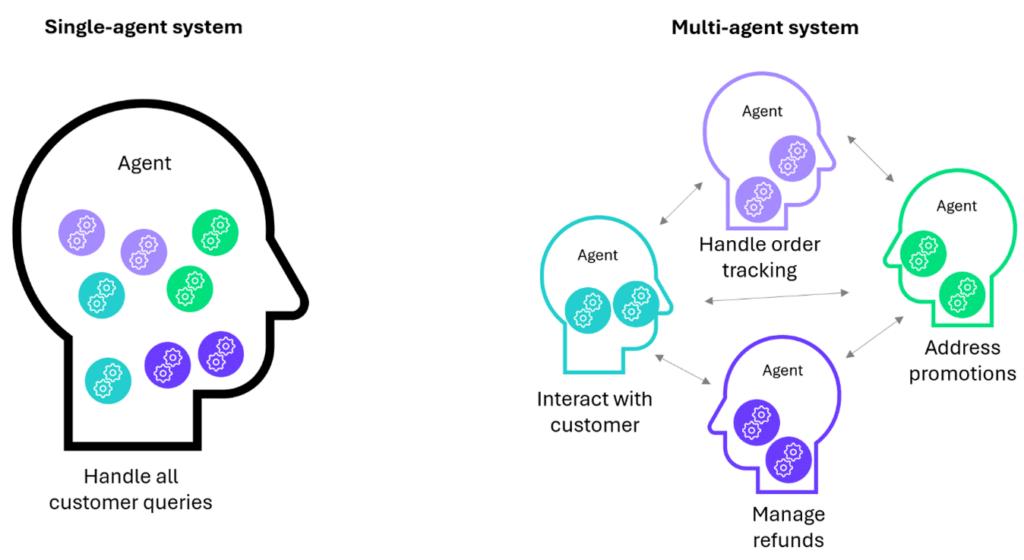
What is needed to design GenAI agents?
Whether you’re automating customer support, enhancing business processes, or revolutionizing healthcare, building effective GenAI agents is a strategic endeavor that requires expertise across multiple disciplines.
At the core of building a GenAI agent is the integration of key components that enable its functionality and adaptability:
- Data engineering. The foundation of any GenAI agent is its ability to access and process data from multiple sources. This includes integrating APIs, databases, and real-time data streams, ensuring the agent can interact with the world outside its own environment. Effective data engineering enables an agent to access up-to-date information, making it dynamic and capable of handling a variety of tasks.
- Prompt engineering. For a large language model to perform effectively in a specific domain, it must be tailored through prompt engineering. This involves crafting the right inputs to guide the agent’s responses and behavior. Whether it’s automating customer inquiries or analyzing medical data, domain-specific prompts ensure that the agent’s actions are relevant, accurate, and efficient.
- Experimentation. Designing workflows for GenAI agents requires balancing autonomy with accuracy. During experimentation, developers must refine the agent’s decision-making process, ensuring it can handle complex tasks autonomously while maintaining the precision needed to deliver valuable results. This iterative process of testing and optimizing is key to developing agents that operate efficiently in real-world scenarios.
- Ethics and governance. With the immense potential of GenAI agents comes the responsibility to ensure they are used ethically. This means designing systems that protect sensitive data, comply with regulations, and operate transparently. Ensuring ethical behavior isn’t just about compliance—it’s about building trust with users and maintaining accountability in AI-driven processes.
Transform potential into performance with GenAI
Whether you win or lose in your market may soon rely on having the best GenAI capability and the data foundations to support it. We can help you build this.
Explore our Generative AI servicesChallenges and pitfalls with GenAI agents
While GenAI agents hold tremendous potential, there are challenges that need careful consideration:
- Complexity in multi-agent systems. Coordinating multiple specialized agents can introduce complexity, especially in ensuring seamless communication and task execution.
- Cost vs. benefit. With resource-intensive models, balancing the sophistication of GenAI agents with the cost of deployment is crucial.
- Data privacy and security. As GenAI agents require access to vast data and tools, ensuring the protection of sensitive information becomes a top priority.
- Ethical and regulatory considerations. Bias in training data, dilemmas around autonomous decision-making, and challenges in adhering to legal and industry-specific standards create significant risks. Deploying these agents responsibly requires addressing ethical concerns while navigating complex regulatory frameworks to ensure compliance.
- Performance management. Implementing agent systems effectively requires overcoming the complexity of monitoring and optimizing their performance. From breaking down reasoning steps to preparing systems and data for smooth access, managing the performance of these agents as they scale remains a significant hurdle.
Unlocking the future of GenAI agents with insights and discoveries ahead - stay tuned!
GenAI agents represent an exciting shift in how we approach problem-solving and human-computer interaction. With their promise to reason, plan, and execute tasks autonomously, these agents have the potential to tackle even the most complex workflows. As we continue our exploration of these systems, our focus will remain on understanding both their immense promise and the challenges they present.
In the coming weeks, we will delve deeper into the areas where GenAI agents excel, where they struggle, and what can be done to enhance their real-world effectiveness. We invite you to follow along with us as we share our experiments, findings, and practical insights from this ongoing journey. Stay tuned for our next blog post, where we will explore the evolving landscape of GenAI agents, along with the valuable lessons we have learned through experimentation.
This article was written by Mirte Pruppers, Data Scientist, Phebe Langens, Data Scientist, and Simon Koolstra, Principal at Rewire.